Industrial pallet stability directly impacts product damage rates, transportation safety, and logistics costs. Among the most common load containment materials, choosing the right high-quality stretch film plays a critical role in securing goods during storage and transit.
However, not all stretch films perform the same. The debate between cast and blown stretch film is about mechanical performance, molecular orientation, cost efficiency, and application compatibility. This technical guide, backed by Juhong’s 28 years of manufacturing expertise, explains the factors that determine the best film for your operation.
Quick Technical Comparison Summary
If you need a fast answer:
Cast stretch film offers superior clarity, quieter unwinding, better thickness consistency, and lower production cost.
Blown stretch film provides higher puncture resistance, stronger tear control, and better load containment for irregular or heavy pallets.
The best choice depends on load geometry, transport stress, and automation level.
For industrial decision-makers, the correct film is the one that minimizes total packaging cost while maintaining load integrity.
Understanding the Manufacturing Differences
Cast film specifically to reduce workplace noiseBoth cast and blown stretch films are typically produced from Linear Low-Density Polyethylene (LLDPE). The performance differences originate from the extrusion and cooling methods.
Cast Stretch Film: Rapid Cooling for Clarity

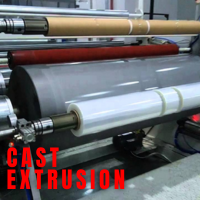
Produced using a flat die system, cast film is cooled rapidly via chill rolls. This minimizes crystalline structure formation, resulting in high optical clarity and excellent thickness control. molecular orientation occurs mainly in the machine direction (MD).
Cast Stretch Film Production Process

Cast stretch film is manufactured using a flat die extrusion system:
Resin pellets are melted in multiple extruders.
Molten polymer layers are combined through a precision multi-layer T-die.
The film is cast onto chilled chrome rollers.
Rapid cooling solidifies the film.
Edge trimming and automatic thickness control systems ensure uniform gauge.
Key technical characteristic: Rapid cooling via chill rolls.
Rapid cooling reduces crystalline structure formation, resulting in:
Because cooling is fast and controlled, molecular orientation occurs mainly in the machine direction (MD).
Blown Stretch Film: Biaxial Strength

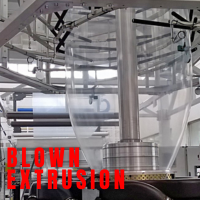
Blown film uses circular die extrusion where air pressure inflates the polymer into a bubble. The gradual air cooling allows molecules to stretch in both Machine Direction (MD) and Transverse Direction (TD). This balanced orientation significantly for applications requiring specific industrial load containment standards , it's vital to compare these mechanical limits
Blown Stretch Film Production Process

Blown stretch film uses circular die extrusion:
Molten polymer exits through a circular die.
Air pressure inflates the polymer into a bubble.
The bubble is cooled gradually by air rings.
The bubble collapses into a flat film.
Key technical characteristic: Slow air cooling and biaxial orientation.
As the bubble expands, molecules stretch in both:
This balanced orientation increases:
Puncture resistance
Tear resistance
Load holding force
However, slower cooling results in lower transparency compared to cast film.
Mechanical Performance Comparison for Industrial Palletizing
Stretch film performance is measured not only by thickness but by force retention and resistance under dynamic load stress.
Puncture Resistance
Blown film typically performs better under sharp corner stress.
Why?
The balanced molecular orientation distributes force more evenly across the film structure. This makes blown film suitable for:
Metal components
Machinery parts
Heavy irregular loads
Cast film performs well for smooth, boxed goods but may be less resistant to concentrated point stress.
Tear Resistance and Propagation Control
Blown film has stronger resistance to tear propagation.
If punctured, the tear spreads more slowly compared to cast film.
This is especially important during:
Forklift handling
Cross-docking
Long-haul trucking
Load Retention and Film Memory
Load retention is the ability to maintain containment force over time. Blown film offers higher holding force and better recovery. However, for extreme stability in high-tensile applications, we often recommend pairing it with PET strapping for ultimate security.
Optical and Operational Characteristics
Clarity and Product Visibility
Cast film offers superior clarity due to rapid chill-roll cooling.
Benefits include:
Blown film has higher haze levels.
Noise During Application
Blown film typically produces more noise during unwinding due to surface texture.
Cast film unwinds quietly, making it preferred in:
Thickness Consistency
Cast film generally has tighter thickness tolerance.
This improves:
Stretch predictability
Machine performance
Film yield control
Core Technical Parameter Comparison Table
| Technical Parameter | Cast Stretch Film | Blown Stretch Film |
| Cooling Method | Chill Roll | Air Cooling |
| Molecular Orientation | Primarily MD | Balanced MD + TD |
| Optical Clarity | High | Moderate |
| Puncture Resistance | Medium | High |
| Tear Resistance | Moderate | High |
| Load Retention | Good | Very Strong |
| Thickness Uniformity | Excellent | Good |
| Noise Level | Low | Higher |
| Cost Efficiency | Higher | Moderate |
| Automation Compatibility | Excellent | Good |
Cost Structure and Economic Considerations
From a purchasing perspective, material price per kilogram does not equal total packaging cost.
Consider:
Film yield per pallet
Damage rate reduction
Downtime from film breaks
Automation compatibility
Transportation claim cost
Cast film usually offers lower production cost due to higher line speed.Blown film may reduce damage-related losses in heavy-duty applications.
The correct evaluation method is:
Total Cost of Ownership (TCO), not just unit price.
Application Scenarios – When to Choose Cast Stretch Film
Cast film is recommended when:
Loads are uniform and stable
Pallets consist of cartons
High-speed automatic wrapping machines are used
Quiet operation is required
Cost optimization is critical
Common industries:
FMCG distribution
Food packaging
Consumer electronics
Retail logistics centers
Application Scenarios – When to Choose Blown Stretch Film
Blown film is ideal when:
Loads are heavy or irregular
Products have sharp edges
Long-distance transport is involved
Load vibration risk is high
Damage cost is significant
Common industries:
Construction materials
Industrial components
Chemical drums
Machinery parts
Industrial Decision Model for Procurement Teams
Instead of asking “Which is better?”, evaluate:
Average pallet weight
Load geometry
Transport distance
Vibration exposure
Automation speed
Damage claim history
Film pre-stretch ratio
In Juhong’s 28 years of industrial experience, we have observed that high-volume logistics centers prioritize Cast film specifically to reduce workplace decibels, whereas heavy-duty manufacturing plants rely on the superior puncture resistance of Blown film.
If your operation prioritizes efficiency and automation → Cast film may be optimal.
If your operation prioritizes durability and containment strength → Blown film may be superior.
Common Misconceptions About Cast vs Blown Stretch Film
Misconception 1: Thicker film equals stronger film
Strength depends on molecular structure, not only thickness.
Misconception 2: Blown film is always better
Not for uniform pallet loads in automated lines.
Misconception 3: Cast film is low quality
Modern multi-layer cast technology offers excellent mechanical performance.
Environmental and Sustainability Considerations
Both cast and blown films are typically made from LLDPE and are recyclable in regions with plastic recycling systems.
Reducing film thickness through improved stretch performance can significantly lower:
Plastic consumption
Carbon footprint
Packaging waste
Optimizing film type improves sustainability performance.
FAQ
1.Is blown stretch film stronger than cast stretch film?
Blown film generally has higher puncture and tear resistance due to balanced molecular orientation.
2.Why is cast stretch film clearer?
Rapid chill-roll cooling reduces crystallinity, resulting in lower haze and higher transparency.
3.Which film is better for automatic pallet wrapping machines?
Cast stretch film is typically preferred due to consistent thickness and smoother unwinding.
4.Can both films be recycled?
Yes, both are usually made from LLDPE and can be recycled where facilities exist.
5.Does blown film cost more?
Blown film may have slightly higher production cost, but total cost depends on application and damage reduction.
Final Conclusion
Cast and blown stretch films serve different industrial purposes.Cast film excels in clarity, cost efficiency, and high-speed automation compatibility. Blown film provides stronger mechanical performance under demanding load conditions.
Need a professional assessment?
Whether you require the clarity of cast film or the ruggedness of blown film, Juhong provides professional stretch film solutions tailored to your specific logistics risks.
![]() juhong packing materials stretch film Brochure.pdf
juhong packing materials stretch film Brochure.pdf
![]() Juhong-Stretch-Film-ASTM-Performance-SGS-Report.pdf
Juhong-Stretch-Film-ASTM-Performance-SGS-Report.pdf
 简体中文
简体中文