For bricks, timber and heavy palletized goods, PET strapping can be a good packaging option in selected applications. The right decision depends on the load weight, load shape, edge sharpness, transport distance, required tension retention, tool compatibility and safety requirements.
PET strapping is often chosen for palletized loads that may settle during transport, where rust-free packaging, lighter handling and elastic recovery are important. However, PET strapping should not be treated as a universal replacement for steel strapping. For very heavy, rigid, sharp-edged or high-risk industrial loads, buyers should compare PET strapping with steel strapping before making a final decision.
Direct Answer: Can PET Strapping Be Used for Bricks, Timber and Heavy Pallets?
Yes, PET strapping can be used for many brick pallets, timber bundles and heavy pallets when the strap specification, tool system and transport conditions are properly matched. It is especially useful when buyers need rust-free packaging, good tension recovery, safer handling and compatibility with manual or machine packaging operations.
But buyers should not decide only from the word "heavy." A heavy but stable carton pallet, a rough timber bundle, a brick pallet with sharp edges and a rigid metal load may all need different packaging decisions.
Buyers should confirm five things before ordering:
Whether the load has sharp edges or high compression points.
Whether the selected PET strap width, thickness and break strength match the load.
How many straps are used and how the strap layout controls the pallet.
Whether the tool, machine or sealing method can create a reliable joint.
Whether the transport and storage environment may affect package stability.
If the load is extremely heavy, has sharp metal edges, requires very high retained tension, or faces harsh rail/sea transport conditions, steel strapping may still be the safer option.
How to Judge Whether a Heavy Load Is Suitable for PET Strapping
For B2B packaging, PET strapping is not selected by a simple weight label such as "medium-heavy" or "heavy-duty." It should be judged as a packaging system.
| Decision Factor | What Buyers Should Check | Practical Judgment |
| Real load weight | Pallet or bundle weight, load height, center of gravity and number of straps | Heavier loads need stronger PET strap specifications, better strap layout and sometimes steel strapping |
| Strap specification | Width, thickness, break strength, elongation and grade | Use confirmed JUHONG product data instead of guessing from generic online ranges |
| Load shape | Regular pallet, irregular bundle, sharp edges, rough surface or high compression points | Sharp or rough edges may require edge protection or steel strapping |
| Tool or machine | Manual tool, pneumatic tool, battery tool, semi-automatic machine or automatic line | Tool tension range and joint method must match the PET strap |
| Joint method | Friction weld, heat seal, buckle or serrated seal | A strong strap still fails if the joint slips or is not compatible |
| Transport environment | Local handling, domestic truck, export container, long-distance transport, humidity or temperature changes | Long-distance handling requires more attention to tension retention, pallet stability and edge protection |
This is why JUHONG recommends asking for load details before confirming PET strapping specifications. A supplier should not recommend a strap only from the phrase "heavy pallet."
The practical rule is simple: start with the cargo, then choose the strap. For bricks, timber and heavy pallets, buyers should check the real pallet weight, whether the load can settle, whether the edges may cut the strap, what tool will be used, and whether the pallet will face long-distance transport or outdoor storage.
Why Buyers Consider PET Strapping for Heavy Packaging
")
Industrial buyers usually consider PET strapping when they want to improve one or more parts of the packaging system, not just replace one material with another.
Common reasons include:
Reducing rust risk compared with steel strapping.
Improving worker handling because PET is lighter than steel.
Using elastic recovery to help maintain tension when loads settle.
Protecting surfaces that may be scratched by metal strapping.
Supporting manual, pneumatic, battery or automatic strapping operations.
Preparing packaging for brick, timber, logistics, warehouse and export pallet applications.
JUHONG supplies PET strapping for manual and machine packaging operations. For buyers comparing sizes, surface types and core requirements, the selection should be based on the actual packaging application instead of only price per roll.
Application Comparison: Bricks, Timber and Heavy Pallets
Different heavy loads create different packaging risks. A brick pallet, a timber bundle and a mixed industrial pallet may all look like "heavy packaging", but they do not behave the same during storage and transport.
| Application | PET Strapping Can Be Suitable When | Buyers Should Be Careful When | What To Confirm Before Ordering |
| Brick and block pallets | The pallet is well stacked, edge protection is used when needed, and the selected PET strap has enough break strength for the load | Brick corners are sharp, the pallet is unstable, or the load may shift during forklift handling | Strap width, thickness, break strength, number of straps, corner protection and tool type |
| Timber and lumber bundles | The bundle may settle or shrink slightly and needs tension recovery during transport | Timber edges are rough, bundle shape is irregular, or straps may rub during long-distance shipment | Strap grade, surface type, retained tension, edge protection and transport distance |
| Heavy palletized goods | The load is regular, palletized and compatible with PET strap tension | The load is extremely heavy, rigid, sharp-edged, or has high impact risk | Load weight, pallet height, center of gravity, strap layout and sealing method |
| Metal products or aluminum profiles | Surface protection and rust-free securement are important | Edges are sharp or the load needs very high tension | Whether PET is enough or steel strapping is safer |
| Export packaging | PET strapping helps avoid rust staining and can support long-distance handling in selected applications | Sea transport, rail transport or high-value cargo may require stricter safety checks | Transport route, humidity, handling frequency, required documents and packaging safety requirements |
PET Strapping for Brick and Block Packaging

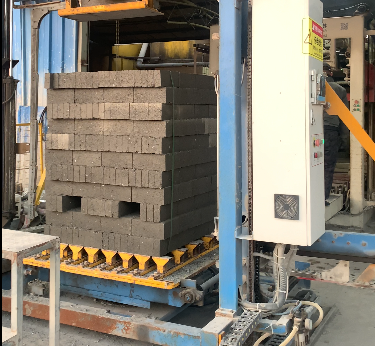
Brick and block packaging often requires strong pallet stability because the load is heavy after stacking, rigid during handling and sometimes rough at the edges. For lightweight blocks such as AAC blocks, the single block may be lighter than traditional bricks, but a full pallet can still create strong movement force during truck transport or container handling. Ordinary packaging strap may break or loosen when the pallet shakes, which can lead to collapsed bricks, product loss or worker safety risks.
PET strapping may be suitable when the bricks are stacked consistently, the pallet is stable, and the packaging design prevents the strap from being cut by sharp edges. For brick factories using automatic bundling lines, machine-use PET strapping is especially important because the strap must run smoothly through the equipment while still providing enough holding force after tensioning and sealing.
Buyers should not only ask, "Can PET strapping hold bricks?" A better question is:
What PET strap specification, strap layout, edge protection and tool system are needed for this brick pallet?
For brick packaging, buyers should confirm:
Pallet weight and pallet height.
Brick or block edge condition.
Whether corner boards or edge protectors are used.
Number of straps per pallet.
Manual or machine strapping operation.
Transport method and handling frequency.
If brick edges cut into the strap or the pallet structure is unstable, the problem may not be PET strapping itself. It may be a mismatch between strap specification, pallet stacking, edge protection and tensioning method.
PET Strapping for Timber and Lumber Bundles

Timber and lumber can change shape slightly during storage and transport because wood bundles may settle, dry, shrink or shift. This is one reason buyers compare PET strapping with steel strapping.
PET strapping has elastic recovery, which can help maintain packaging tension when the load settles. This makes it useful for selected timber and lumber applications. It can also reduce rust staining concerns and improve handling compared with steel strap.
However, buyers should check rough surfaces and sharp edges. If the timber surface is uneven or the bundle has high friction points, edge protection and correct strap tension become more important.
For timber packaging, buyers should confirm:
Bundle size and weight.
Whether the timber is dry, wet, rough or freshly processed.
Storage and transport duration.
Strap contact points.
Whether the bundle may settle during transport.
Tool type and sealing method.
For distributors supplying timber customers, a simple product description is not enough. The buyer should provide application details so the PET strapping supplier can recommend a suitable width, thickness, surface type and packing method.
PET Strapping for Heavy Pallets
(1)(1)")
"Heavy pallets" can include building materials, cartons, metal products, aluminum profiles, logistics goods and industrial components. PET strapping can work well for many pallet loads, but the packaging system must be considered as a whole.
Important factors include:
Pallet weight.
Load stability.
Load edge condition.
Required tension.
Strap elongation and recovery.
Tool or machine compatibility.
Transport distance.
Forklift and warehouse handling.
Buyers should avoid choosing PET strapping only by roll price. A cheaper strap that is too narrow, too thin or not compatible with the tool may create higher risk during shipment. For technical selection, the PET strapping roll specifications page can support width, thickness, core size and specification discussion, but final details should be confirmed according to the actual order.
When PET Strapping Is a Good Choice
PET strapping is often a good choice when:
The load is heavy but not extremely sharp-edged.
The buyer wants rust-free securement.
The packaging needs some tension recovery after load settling.
The product surface should avoid metal strap scratches.
Manual, pneumatic, battery or automatic PET strapping tools are available.
The buyer needs a lighter and easier-to-handle alternative to steel in selected applications.
The load is palletized, stacked consistently and supported by proper packaging design.
For buyers using packaging machines, machine-grade polyester strapping may be more suitable than manual-grade PET strapping because feeding stability, consistent dimensions and core compatibility become more important.
For lower-volume or manual packaging operations, manual PET strapping may be considered when the strap specification and tool system match the load.
When Steel Strapping May Be Safer
PET strapping is not the best answer for every heavy load. Steel strapping may be safer when the load is extremely heavy, rigid, sharp-edged, or exposed to high impact during transport.
Buyers should consider steel strapping when:
The load has sharp metal edges.
The load is highly compressed or very rigid.
The cargo is very heavy and requires higher retained tension.
The route includes severe handling, long-distance sea shipment or rail transport.
Packaging failure would create serious safety or product-loss risk.
The existing packaging system is already designed around steel straps, steel seals and steel strapping tools.
For buyers comparing material replacement, JUHONG's steel-to-PET comparison article can help explain why switching from steel to PET should be limited to selected applications, not treated as a universal rule: switching from steel to PET strapping.
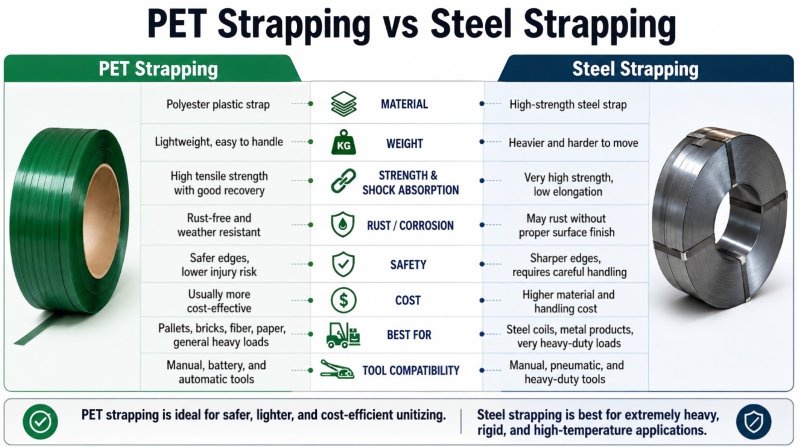
PET Strapping vs Steel Strapping for Heavy Loads

| Factor | PET Strapping | Steel Strapping |
| Rust risk | Rust-free and suitable when buyers want to avoid metal rust staining | May need proper surface finish for humid storage or export routes |
| Handling | Lighter and easier to handle | Heavier and requires more careful handling |
| Tension recovery | Good elastic recovery for loads that settle | Strong retained tension for rigid heavy loads |
| Surface protection | Gentler for many finished surfaces | May scratch some surfaces if not protected |
| Sharp-edge resistance | Needs edge protection when load edges are rough or sharp | Better suited for sharp-edged and very rigid industrial loads |
| Tool compatibility | Manual, pneumatic, battery and automatic PET systems depending on grade | Steel strapping tools, sealers, cutters and seals must match strap size |
| Best-fit applications | Bricks, timber, pallets, logistics and selected export packaging | Steel coils, metal bundles, machinery, sharp-edged and very heavy loads |
What Specification Details Should Buyers Confirm?

For bricks, timber and heavy pallets, the most important question is not only "PET or steel?" It is whether the selected strap specification matches the packaging risk.
| Specification Factor | What Buyers Should Check | Why It Matters |
| Width | Match strap width with load weight, pallet size and tool compatibility | Too narrow a strap may not provide enough load distribution |
| Thickness | Confirm thickness according to load and required strength | Too thin a strap may increase failure risk under heavy tension |
| Break strength | Confirm required break strength from the actual packaging application | Helps prevent strap failure during handling and transport |
| Elongation / recovery | Check whether the load may settle or shrink | PET recovery helps maintain tension in selected applications |
| Surface type | Smooth or embossed, depending on machine, tool and joint method | Surface can affect feeding, friction and joint stability |
| Core size | Confirm manual roll or machine roll requirements | Wrong core size may not fit the dispenser or machine |
| Tool type | Manual, pneumatic, battery or automatic machine | Tool mismatch can cause poor tension or weak joints |
| Sealing method | Friction weld, heat seal, buckle or serrated seal depending on operation | Joint strength is part of the full packaging system |
JUHONG PET strapping covers common widths from 9 to 32 mm and thicknesses from 0.38 to 1.5 mm, allowing buyers to match lighter pallet packaging, brick pallets, timber bundles and heavier industrial loads with different strap specifications.
For a buyer, this means the question should not be "Is PET strapping strong?" The better question is:
Which PET strapping width, thickness, strength grade and tool setup match this pallet?
JUHONG PET Strapping Strength Grades
For PET strapping selection, JUHONG can supply different strength grades according to the buyer's packaging load, transport route and equipment setup. The grade is not just a letter. It tells the buyer the tensile strength level of the PET material and whether the strap is more suitable for hand packing, machine packing or heavier export packaging.
| JUHONG PET Grade | Tensile Strength Range | Common Use Direction | Suitable Packaging Scenarios |
| L grade | 301-382 MPa | Regular hand-use and machine-use grade | Cartons, lighter pallets, stable brick or block pallets, general factory bundling and stable loads where the strap size and tool setup are correctly matched |
| M grade | 383-411 MPa | Regular hand-use and machine-use grade | Automatic brick or block strapping lines, medium-duty pallets, timber bundles, building materials and export packaging that need better consistency with manual tools or strapping machines |
| H grade | 412-441 MPa | Common export heavy-duty grade | Heavier timber packs, metal products and heavier industrial loads where stronger holding force and better transport stability are required |
| S grade | 442-490 MPa or above | Extra high-strength grade for special requirements | Long-distance transport, rough handling, heavier pallets or applications where the buyer asks for a stronger PET strapping specification |
For buyers, the practical selection logic is simple:
If the buyer uses manual tools for regular cartons or lighter pallets, L grade is often the basic option. Some stable brick or block packaging can also use an L-grade specification when the width, thickness, machine tension and pallet structure are suitable.
If the buyer needs one grade for both hand packing and machine packing, M grade is usually a practical middle choice.
If the goods are heavier timber packs, metal products or higher-risk export pallets, H grade is usually a stronger starting point.
If the load is heavy, has sharp corners, needs long-distance shipping, or has a higher safety requirement, S grade should be discussed.
One real JUHONG application case is a brick factory customer using 15 x 0.8 mm smooth machine-use PET strapping for brick pallet packaging. This specification provides about 4700 N tensile strength and met the customer's regular brick packaging needs on their machine strapping line.
For applications with higher load-security requirements, buyers can choose PET strapping with a higher tensile strength grade. If a buyer needs to compare MPa, N and lbf, use these simple formulas:
For brick or AAC block packaging, buyers should not choose ordinary strap only by size. A machine-use PET strap for automatic brick strapping lines needs stable feeding, consistent welding or sealing, and enough tensile strength to resist vibration during transport.
If the buyer requires AAR PET strapping, it should be handled as a separate product requirement, not as another ordinary strength grade. AAR PET strapping should be matched with the correct verified product file and certificate.
For heavy-load selection, use this logic:
Confirm the actual pallet or bundle weight.
Confirm whether the load is stable, settling, rough-edged or sharp-edged.
Confirm the planned number and direction of PET straps.
Match strap width, thickness, break strength and grade with the application.
Confirm whether manual-grade or machine-grade PET strapping is required.
Confirm whether a test report or certification is needed for the order.
Buyer Checklist Before Requesting a PET Strapping Quote
Before asking for a PET strapping quotation, buyers should prepare the following information:
| Buyer Information | Example Details To Provide |
| Product packed | Bricks, blocks, timber, lumber, cartons, aluminum profiles, metal products, heavy pallets |
| Load weight | Pallet or bundle weight range, if available |
| Load shape | Regular pallet, irregular bundle, sharp edges, rough surface, unstable stack |
| Transport route | Local warehouse transfer, domestic trucking, export container, rail transport, sea shipment |
| Packaging operation | Manual tool, pneumatic tool, battery tool, semi-automatic or automatic strapping machine |
| Current problem | Loose straps, broken straps, rust concern, surface scratching, tool mismatch, high cost |
| Required strap details | Width, thickness, color, smooth/embossed surface, roll weight, core size |
| Grade / strength target | Required tensile strength level, break strength, or AAR PET requirement if the buyer has one |
| Documentation needs | ASTM, AAR, SGS, REACH, RoHS, SDS or other documents if required for the specific order |
If the buyer is not sure which specification to choose, JUHONG can review the application details and suggest a suitable direction based on product type, load condition and packaging method. Exact specifications need to be confirmed according to the latest product data and order requirements.
Common Mistakes Buyers Should Avoid
Choosing PET strapping only by price
Low price does not always reduce packaging cost. If the strap is not strong enough, does not match the tool, or fails during transport, the total cost can be much higher.
Assuming PET can replace steel in every heavy-duty application
PET can replace steel in selected applications, but not all. Sharp-edged, extremely heavy or high-risk cargo may still need steel strapping.
Ignoring edge protection
Bricks, timber and industrial products can have rough or sharp contact points. Edge protection may be necessary to prevent strap damage.
Using the wrong tool or machine
Manual-grade and machine-grade PET strapping are not the same purchasing decision. Tool compatibility affects tension, joint quality and packaging consistency.
Not providing load details to the supplier
A supplier cannot recommend the right PET strap only from the words "heavy pallet." Buyers should provide product type, weight, transport route, tool type and current packaging problems.
FAQ
1.Can PET strapping be used for brick pallets?
Yes, PET strapping can be used for selected brick and block pallets when the pallet is stable, the strap specification is suitable, and edge protection is used where needed. Buyers should confirm pallet weight, brick edge condition, strap size, tool type and transport route before ordering.
2.Is PET strapping strong enough for timber packaging?
PET strapping can be suitable for timber and lumber bundles because it offers tension recovery when loads settle. However, rough surfaces, sharp edges and long-distance transport conditions should be checked before replacing steel strapping.
3.Can PET strapping replace steel strapping for heavy pallets?
PET strapping can replace steel strapping in selected applications, but not in every heavy-duty packaging situation. For extremely heavy, rigid or sharp-edged loads, steel strapping may still be safer.
4.What PET strap size should buyers use for heavy loads?
The correct size depends on load weight, pallet shape, required break strength, tool compatibility and transport conditions. Specific width, thickness and break-strength values need to be confirmed with the latest JUHONG product information.
5.Is smooth or embossed PET strapping better for heavy pallets?
Both can be used depending on the tool, machine and sealing method. Embossed PET strapping may help increase friction in some applications, while smooth PET strapping may be preferred for certain machines. Buyers should confirm compatibility before ordering.
6.Should buyers choose manual-grade or machine-grade PET strapping?
Manual-grade PET strapping is usually selected for hand tools or lower-volume packaging. Machine-grade PET strapping is designed for higher-volume or automatic packaging lines where feeding stability and consistent dimensions are important.
7.What information should I send before requesting a PET strapping quote?
Send the product packed, load weight, pallet size, transport route, tool or machine type, current packaging problem, required strap size if known, and any documentation requirements.
CTA
If you are comparing PET strapping for bricks, timber, heavy pallets or export packaging, send JUHONG your load type, pallet weight, transport route, tool type and current packaging problem. Our team can help review whether PET strapping is suitable, which specification direction should be considered, and when steel strapping may be the safer option.
Contact JUHONG to request PET strapping specifications or quotation support
![]() Brochure_Juhong Strapping_Packing Material.pdf
Brochure_Juhong Strapping_Packing Material.pdf
 简体中文
简体中文