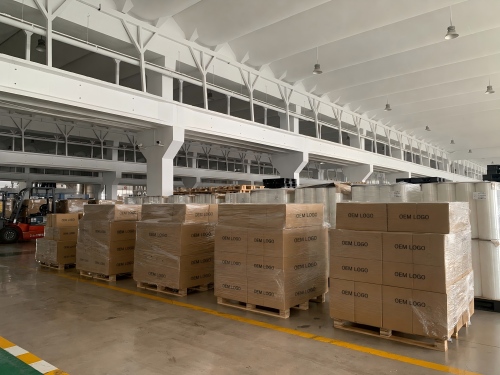
Choosing machine stretch film is not just a thickness decision. A 20 micron film may perform better than a 25 micron film in one wrapping line, while the same 20 micron film may break, neck down, or lose load stability in another line.
The right choice depends on three things: the pallet wrapping machine, the load being wrapped, and the film specification being tested. In practice, buyers should check the wrapper's pre-stretch ratio and tension control, the pallet's weight, shape and transport risk, and the film's thickness, elongation, puncture resistance, cling, roll quality, core stability, and cost per wrapped pallet before changing specifications.
JUHONG supplies machine stretch film for automatic and high-frequency pallet wrapping applications. For many industrial buyers, the practical goal is simple: keep pallets stable, reduce film breaks, and avoid using more film than the load actually needs.
Direct Answer: How Should Buyers Choose Machine Stretch Film?
Buyers should choose machine stretch film by matching the film to the wrapper's pre-stretch system, the pallet load profile, and the expected transport risk. A film used on a basic turntable wrapper may not need the same elongation performance as a film used on a high-speed in-line wrapping system. Heavy or sharp-edged loads may need stronger puncture resistance, while stable cartons on regular pallets may allow down-gauging from a thicker film to a thinner high-performance film after testing.
As a practical starting point, confirm these four points before ordering:
| Selection Factor | What Buyers Should Confirm | Why It Matters |
| Machine type | Turntable, rotary arm, ring, horizontal/orbital, robot/mobile, or in-line wrapper | Different machines apply film tension and pre-stretch in different ways |
| Pre-stretch ratio | Whether the machine uses low, medium, or high pre-stretch | Film must elongate without breaking or losing load containment |
| Load profile | Weight, shape, pallet height, sharp edges, stability, and transport distance | Load risk decides whether buyers need thinner film, thicker film, or higher puncture resistance |
| Film specification | Thickness, width, roll weight, elongation, cling, puncture resistance, and core quality | Incorrect film may cause breakage, poor wrapping, high consumption, or unstable pallets |
JUHONG stretch film can be supplied with elongation performance from about 150% to 500%, depending on film thickness, formulation, application method, wrapper settings, and project requirements. For machine wrapping applications, the suitable elongation range should be matched with the wrapper's pre-stretch capability and confirmed through trial wrapping.
This does not mean every film should be stretched to the highest possible percentage. The best film is the one that keeps the pallet stable at the lowest safe film consumption on the buyer's actual machine.
Why Machine Type Changes the Film Choice

Machine stretch film works together with the wrapper. If the machine cannot pre-stretch the film consistently, a very thin or very high-elongation film may not deliver the expected saving. If the machine is high-speed and well maintained, a thicker standard film may waste material.
That is why buyers should not select machine wrap film by thickness alone. The same 17 micron film can behave differently on a turntable wrapper, a rotary arm wrapper, or a high-speed in-line system.
Machine Stretch Film Selection by Wrapping Machine Type
| Pallet Wrapping Machine Type | Typical Wrapping Situation | Film Selection Focus | Buyer Notes |
| Turntable wrapper | The pallet rotates while the film carriage moves up and down | Stable thickness, smooth unwinding, suitable elongation, good cling | Good for regular pallets and common warehouse packaging. Check whether the load is stable enough to rotate. |
| Rotary arm wrapper | The pallet stays still while the arm rotates around it | Strong load retention, puncture resistance, stable film tension | Better for heavy, unstable, tall, or fragile loads that should not rotate. |
| Ring wrapper | High-speed wrapping with a ring-style film system | High elongation, low breakage, stable roll quality, consistent thickness | Often used in automated lines. Film quality must be consistent because downtime is costly. |
| Horizontal or orbital wrapper | Film wraps around long or irregular products horizontally | Tear resistance, edge protection, cling, suitable width | Used for long items, profiles, boards, pipes, or products that do not fit standard pallet wrapping logic. |
| Robot or mobile stretch wrapper | The machine moves around the pallet | Smooth unwinding, adaptable film performance, reliable cling | Useful for different pallet sizes or flexible warehouse layouts. Check machine tension settings carefully. |
| In-line wrapper | Integrated automatic packaging line | Core stability, roll consistency, high-speed compatibility, low breakage | Best matched with tested machine film. Small film problems can affect the whole packaging line. |
After identifying the wrapper type, buyers should confirm the actual pallet weight, load shape, storage condition, transport route, and machine pre-stretch setting before selecting the final film specification.
Match Film to Machine Pre-Stretch Capability

Pre-stretch is one of the most important factors in machine film selection. It means the machine stretches the film before applying it to the pallet. A higher pre-stretch ratio can reduce film use, but only when the film and machine are compatible.
| Machine / Pre-Stretch Situation | Practical Film Direction | What to Watch |
| Conventional or low pre-stretch wrapper | Standard machine film with enough thickness and stable tension behavior | Do not force very thin film if the machine cannot stretch and control it properly |
| Semi-automatic pre-stretch wrapper | Machine film with medium to high elongation and stable thickness | Test whether the film breaks at corners, during acceleration, or at the bottom wraps |
| Fully automatic or high-efficiency wrapper | Higher elongation machine film with stronger consistency and lower breakage risk | Confirm pre-stretch setting, film carriage condition, roll quality, core strength, and load containment |
| Special wrapper or custom wrapping line | Film should be selected after checking load shape, machine layout, and wrapping path | For ring, orbital, or irregular wrapping, film width and tear resistance may matter more than simple thickness |
Some high-speed wrapping systems may be designed to work with premium nano-layer stretch film, especially when buyers want very thin film and high pre-stretch performance. If a buyer specifically requires nano-layer film, this should be confirmed separately with the film supplier and machine manufacturer. JUHONG can help buyers evaluate machine stretch film requirements based on pre-stretch ratio, thickness, elongation, puncture resistance, and wrapping performance, but nano-layer film supply needs to be confirmed separately.
Match Film Thickness to the Load Profile
Film thickness should follow the load, not only the machine. A thinner film may reduce cost for regular stable pallets, but heavy or sharp-edged loads may need higher puncture resistance or a thicker specification.
| Load Profile | Typical Film Direction | Why |
| Light and regular cartons | 12-15 micron may be tested when the pallet is stable and transport risk is low | Reduces unnecessary material use when load containment is not demanding |
| Standard pallet loads | 15-20 micron is often tested for balanced cost and performance | Common option for daily warehouse and export pallet wrapping |
| Medium-heavy regular loads | 17-23 micron may be used depending on pallet height, machine setting, and shipping distance | Provides stronger holding force and better transport safety |
| Heavy, sharp, or irregular loads | 20-23 micron and above, or higher puncture-resistant film, may be required | Sharp corners, rough surfaces, and cargo movement increase film failure risk |
| High-speed automatic line | Lower thickness may be possible if elongation and consistency are strong enough | The film must maintain stable performance under continuous machine operation |
These ranges are practical references, not fixed rules. Buyers should test the film on their actual machine with their actual pallet load before changing specifications.
Real Case: A Plastic Masterbatch Factory Reduced Stretch Film Cost by About 30%
In 2026, a plastic masterbatch factory was using 25 micron machine stretch film for pallet wrapping. The film provided enough protection, but the buyer wanted to reduce packaging cost without creating pallet instability or increasing film breakage risk.
After reviewing the customer's wrapping application, load condition, and machine wrapping requirements, JUHONG recommended testing 20 micron machine stretch film instead of the original 25 micron film.
The point was not simply to use a thinner film. The customer needed to confirm whether a 20 micron film with suitable elongation, cling, puncture resistance, thickness consistency, and load retention could still meet the factory's packaging requirement.
After the trial, the customer switched from 25 micron to 20 micron machine stretch film and reduced stretch film cost by about 30% in this specific application while maintaining acceptable pallet wrapping performance.
This case shows an important rule: thicker film is not always the safer or more economical choice. For stable pallet loads and suitable wrapping machines, a thinner high-performance machine stretch film may reduce unnecessary material consumption. However, the result depends on the actual machine, load weight, pallet shape, pre-stretch setting, wrapping layers, storage condition, and transport route.
Buyers should not assume that every 25 micron film can be replaced by 20 micron film. The correct way is to run a small trial, compare film consumption per pallet, check load stability, and inspect the wrapped pallets after handling or transport.
Cast Film, Blown Film, and High-Performance Film: What Should Buyers Know?

Most machine stretch film buyers compare film by thickness first, but formulation also matters.
| Film Direction | Practical Strength | Common Buyer Fit |
| Cast stretch film | Clear appearance, quiet unwinding, stable thickness, good processing efficiency | Common pallet wrapping, warehouse packaging, standard machine use |
| Blown stretch film | Stronger puncture and tear resistance in many applications, often tackier and noisier | Heavy, irregular, or sharp-edged loads when stronger puncture resistance is needed |
| High-performance machine film | Better elongation, possible down-gauging, lower film consumption in suitable applications | Automatic wrappers, high-frequency wrapping, cost optimization projects |
| Specialty film | UV-resistant, colored, opaque, anti-static, or other project-based requirements | Needs confirmation according to storage, cargo, market, and application |
When JUHONG recommends machine stretch film, we usually check more than the micron number. For regular pallet wrapping, we look at film thickness, elongation, puncture resistance, cling, roll consistency, roll weight, core condition, and the buyer's machine setting. If the buyer needs colored film, anti-static film, UV resistance, food-contact use, or special compliance documents, those details should be confirmed according to the actual order and latest product information.
Common Mistakes When Selecting Machine Stretch Film
Mistake 1: Choosing by Thickness Only
A 23 micron film is not automatically better than a 17 micron film. Thickness matters, but buyers also need to compare elongation, puncture resistance, load retention, cling, and machine compatibility.
Mistake 2: Ignoring Pre-Stretch Settings
If the wrapper is set incorrectly, even a good film may break. Buyers should check machine pre-stretch ratio, film tension, carriage rollers, edge damage, and roll alignment before blaming the film.
Mistake 3: Using the Same Film for Every Load
Regular cartons, bagged goods, metal parts, building materials, and unstable mixed pallets may need different film performance. The same film may be cost-effective for one load and risky for another.
Mistake 4: Trying to Down-Gauge Without Testing
Down-gauging can reduce cost, but it should be verified by trial wrapping. Buyers should compare cost per pallet, not only price per roll.
Mistake 5: Forgetting Storage and Roll Handling
Even a suitable film can perform poorly if the roll edge is damaged, the core is deformed, or the film is stored in heat, moisture, dust, or direct sunlight. Before testing a new machine film, buyers should also check how stretch film rolls are stored before use.
Buyer Checklist Before Ordering Machine Stretch Film

Before asking for a quotation, prepare these details. It helps the supplier recommend a practical specification instead of guessing.
| Buyer Information | Why It Helps |
| Wrapper type and model | Decides whether the film should match turntable, rotary arm, ring, robot, orbital, or in-line wrapping |
| Pre-stretch ratio or machine setting | Helps choose elongation range and avoid film breakage |
| Current film thickness and roll size | Gives a baseline for cost and performance comparison |
| Pallet weight and height | Helps estimate load containment requirement |
| Product type | Cartons, bags, bottles, metal parts, building materials, or irregular products create different risks |
| Sharp edges or rough surfaces | Decides whether puncture-resistant film or edge protection is needed |
| Transport distance | Export shipping and long-distance trucking may need stronger load retention |
| Current problem | High film cost, film breaks, loose pallets, poor cling, roll edge damage, or machine downtime |
| Target goal | Cost reduction, stable wrapping, less breakage, higher speed, or specification standardization |
If buyers are comparing stretch film suppliers, this information also helps them evaluate whether the supplier understands real pallet wrapping conditions, not only roll price.
How to Test Machine Stretch Film Before Changing Specifications
A small trial is the safest way to change film thickness or grade.
Record the current film thickness, roll weight, pallet load, machine setting, and film consumption per pallet.
Test the new film on the same machine and same type of load.
Check film breakage during start, corner wrapping, top wrapping, and bottom wrapping.
Compare the number of wraps, load stability, cling, puncture marks, and edge tearing.
Move or transport the wrapped pallet if possible, then inspect whether the load shifts.
Calculate cost per pallet, not only price per kilogram or price per roll.
Keep the old specification available until the new film is confirmed stable.
For buyers using both manual and automatic wrapping, it may also be useful to compare hand stretch film and machine film separately. Hand film and machine film are not simply interchangeable because roll weight, elongation, tension control, and operating method are different.
When Should Buyers Use Thicker Film Instead of Down-Gauging?
Down-gauging is useful only when the load allows it. Buyers should stay with a thicker film or choose higher puncture resistance when:
The pallet has sharp metal, wood, or building material edges.
The load is unstable, mixed, tall, or easy to shift.
The transport route includes long-distance export shipping.
The machine has inconsistent tension or poor pre-stretch control.
Film breaks appear repeatedly at the same corner or edge.
The wrapped pallets loosen after handling or storage.
In these cases, reducing thickness too quickly may create hidden costs: damaged cargo, rewrapping, customer complaints, and machine downtime.
FAQ
1.What is the best machine stretch film for pallet wrapping machines?
The best machine stretch film is the one that matches the wrapper's pre-stretch capability, the pallet load, the transport risk, and the buyer's cost target. For regular pallets, buyers may test thinner high-performance film. For heavy or sharp-edged loads, stronger puncture resistance or thicker film may be safer.
2.Can JUHONG machine stretch film reach 300% or 400% elongation?
JUHONG stretch film can be supplied with elongation performance from about 150% to 500%, depending on film thickness, formulation, machine setting, application method, and project requirements. For machine stretch film, the suitable elongation range should be matched with the wrapper's pre-stretch capability and verified through trial wrapping.
3.Does every machine need high elongation stretch film?
No. High elongation is useful only when the machine can pre-stretch and apply the film correctly. A conventional or poorly adjusted wrapper may not benefit from very high elongation film. Buyers should match film performance with machine capability.
4.Can 20 micron machine stretch film replace 25 micron film?
Sometimes, but not always. In one 2026 JUHONG case, a plastic masterbatch factory changed from 25 micron to 20 micron machine stretch film and reduced cost by about 30% after testing. This result depends on load stability, machine setting, film performance, and transport conditions.
5.Is nano-layer stretch film required for high-speed wrappers?
Some high-speed wrappers may be designed to work with nano-layer stretch film, especially for very thin film and high pre-stretch applications. However, not every line needs nano-layer film. If a buyer specifically requires nano-layer film, supply should be confirmed separately.
6.Why does machine stretch film break during wrapping?
Common causes include excessive pre-stretch, damaged roll edges, poor roll storage, sharp pallet corners, unsuitable film thickness, weak puncture resistance, incorrect tension setting, or unstable machine rollers. Buyers can also read JUHONG's stretch film breakage troubleshooting guide.
7.What should buyers send before asking for a machine stretch film quote?
Send the wrapper type, pre-stretch ratio, current film thickness, roll size, pallet weight, product type, sharp edge condition, transport distance, current problem, and target goal. This helps JUHONG recommend a more practical machine stretch film specification.
Conclusion: Choose Film by Machine, Load, and Test Result
Machine stretch film should not be selected by thickness alone. Buyers should match the film with the pallet wrapping machine type, pre-stretch capability, load profile, transport risk, and cost target.
For regular stable pallets, a thinner high-performance film may reduce unnecessary film consumption. For heavy, sharp, or unstable loads, stronger puncture resistance and safer wrapping settings may matter more than using the thinnest possible film.
JUHONG helps buyers evaluate machine stretch film based on elongation, thickness, puncture resistance, cling, load retention, roll consistency, and actual wrapping performance. If you are changing from manual wrapping to automatic wrapping, reducing film thickness, or trying to solve film breakage, contact JUHONG for stretch film specifications and prepare your machine and load details for a practical recommendation.
![]() juhong packing materials stretch film Brochure.pdf
juhong packing materials stretch film Brochure.pdf
 简体中文
简体中文