When buyers choose stretch film, many start with the same question: what thickness should I use? In real pallet wrapping, that is not the best place to start.
The right film is not simply the thickest film or the lowest-priced film. It is the film that matches your pallet load, wrapping method, transport conditions, and packaging goals. A film that works well for stable carton pallets may not perform as well on heavy industrial products, mixed pallet loads, or sharp-edged materials.
For warehouses, distributors, and industrial buyers, choosing the right film can help improve load stability, reduce unnecessary material use, and lower the risk of cargo damage during storage and transportation.
This guide explains how to choose the right stretch film for different pallet loads based on practical factors such as load weight, load shape, wrapping method, and transport risk.
Why Stretch Film Selection Matters for Pallet Stability

The main purpose of stretch film is to unitize palletized goods and keep them secure during handling, storage, and shipment. If the film is not matched to the actual load condition, several problems may happen during use.
The pallet may shift during transportation. Corners may break through the film. The wrap may loosen during storage. In some cases, operators may use too many wraps simply because the film itself is not the right match for the application.
That is why stretch film selection should be based on the actual pallet load, not on thickness alone. A good selection process helps buyers balance packaging safety, wrapping efficiency, and material cost in a more practical way.
Start with the Type of Pallet Load
Before choosing a wrapping solution, it is important to understand what kind of load is being wrapped. Different pallet loads create different packaging risks, and that directly affects film selection.
Uniform and Stable Pallet Loads

Uniform pallet loads are usually the easiest to wrap. These often include neatly stacked cartons, packaged consumer goods, or products with flat sides and a stable top surface.
Because the pallet shape is regular, the film can be applied more evenly, and it is easier to maintain stable wrapping tension. For this kind of load, buyers often focus on wrapping efficiency, clear product visibility, and consistent performance.
Mixed or Slightly Irregular Loads
Some pallets are mostly stable but not completely uniform. Mixed cartons, slight overhang, uneven stacking, or different box sizes can all reduce overall load stability.
These loads require more attention because the force of the wrap may not be distributed evenly across the pallet. In these cases, buyers should look beyond thickness and consider holding force, film toughness, and whether the load will remain secure through movement and transport.
Heavy Pallet Loads
Heavy pallet loads place more stress on the wrapping film during forklift movement, stacking, loading, and transportation. Even if the pallet looks regular, higher weight increases the risk of leaning, shifting, or bottom movement.
For these applications, it is usually better to focus on real containment performance rather than only trying to reduce material usage.
Irregular, Sharp-Edged, or Unstable Loads
This is one of the most demanding wrapping situations. Pallets with sharp corners, protruding parts, rough surfaces, metal products, building materials, or unstable stacking can damage film more easily during wrapping and shipment.
For these loads, puncture resistance and tear resistance become much more important. In some cases, improving the wrapping pattern or adding corner protection may be more effective than simply adding more film.
5 Key Factors to Check Before Choosing Stretch Film
Once the pallet load type is clear, buyers can evaluate the main factors that influence film selection.
1.Load Weight
Load weight is one of the first things to check. In general, heavier loads require stronger containment and more reliable wrapping performance.
A light and stable pallet can often use a lighter film structure, while heavier industrial loads usually need stronger support. At the same time, weight should always be evaluated together with shape, edge condition, and transport conditions.
2.Load Shape and Edge Risk
Load shape has a direct effect on how film performs. Square, flat-sided carton pallets are relatively easy to wrap. Drums, pipes, bags, metal parts, and mixed industrial products are more difficult because they create uneven pressure points.
Sharp edges and rough surfaces increase the risk of puncture and tearing. For these applications, buyers usually need a tougher wrapping solution.
3.Wrapping Method
The wrapping method also matters. Some operations rely on manual application, while larger facilities usually need more stable and efficient machine-based wrapping.
This factor should be considered early in the selection process because the same pallet load may require different film choices depending on how the film is applied.
4.Transport and Storage Conditions
A pallet that moves only inside one warehouse does not face the same risks as a pallet that will be exported, stacked multiple times, or shipped over a long distance.
Long-distance transportation, container loading, repeated handling, and rough storage conditions all increase the need for stable wrapping performance.
5.Packaging Efficiency and Material Use
Many buyers want to reduce film consumption, but the goal should not be to use the thinnest film possible. The goal should be to use the right film for the application.
If the film is too light, it may fail and require rewrapping. If the film is too heavy, packaging cost may increase without improving actual load security. Good selection helps balance safety, efficiency, and cost.
When comparing film options, evaluate cost per pallet wrapped, not just price per roll. A cheaper roll that requires more wraps or breaks more often to secure the same load can end up costing more per pallet than a slightly higher-priced film that wraps faster and holds the load correctly the first time.
Should You Use Hand or Machine Stretch Film for This Load?


This is one of the most important decisions in practical film selection. The right answer depends on pallet volume, wrapping consistency requirements, and the type of operation.
When Hand Stretch Film Makes More Sense
For lower pallet volume, flexible warehouse use, repacking, or smaller daily operations, hand stretch film is often a practical option.
It is commonly used where operators wrap pallets manually and where speed is less important than flexibility. This type of film is suitable for routine warehouse packaging, temporary wrapping, or situations where automatic equipment is not available.
When Machine Stretch Film Is the Better Choice
For higher output and more consistent pallet wrapping, machine stretch film is usually the better fit.
It is more suitable for factories, logistics centers, and export packaging lines where stable wrapping quality and repeatable results matter. When pallet volume is high, machine application can also improve efficiency and reduce variation from one load to another.
If you already know you need machine film, see how to choose machine stretch film for your wrapping machine for wrapper-specific guidance.
Cast or Blown: What Difficult Loads Actually Need
Cast Stretch Film for Regular Loads
For regular carton pallets and smoother wrapping performance, cast stretch film is often preferred.
It is generally a practical choice when buyers want smooth unwind, clear appearance, and efficient wrapping for standard pallet loads. For many warehouse and export packaging applications, cast film is a common option for regular and stable loads.
Blown Stretch Film for Difficult Loads
Some buyers assume a genuinely difficult load always needs blown film,which offers strong tear resistance but is not part of JUHONG's product range. In practice, a cast film with the right thickness, wrap count and edge protection can handle most irregular or sharp-edged loads — see the fiberglass pallet example above, where a heavier 40 micron cast film solved a recurring tear point at the load's sharp corner. For a full technical comparison of the two film types, see our cast vs blown stretch film guide.
Do Not Choose Stretch Film by Thickness Alone
Thickness is important, but it should not be the only decision factor.
Many buyers ask for a specific micron range first, but a better selection process starts with the pallet itself. A thicker film is not automatically the best option. In many cases, a properly matched film can provide good load stability without unnecessary material use.
Instead of asking only what thickness to use, buyers should ask whether the pallet is regular or irregular, whether it has sharp corners, whether it will be wrapped by hand or machine, and whether the shipment will face local storage or long-distance transport.
Once those questions are clear, thickness becomes easier to choose as part of the full wrapping solution.
As a general starting point (always confirm against your actual load weight, shape and wrapping method):
Uniform and stable loads: thinner film within JUHONG's standard 10-20 micron range is often sufficient.
Mixed or slightly irregular loads: 15-25 micron covers most everyday warehouse pallets.
Heavy loads: 20-40 micron, often paired with more wraps at stress points rather than thickness alone.
Irregular, sharp-edged or unstable loads: higher thickness within JUHONG's standard range, combined with extra reinforcing wraps and edge protection. For loads with a genuinely sharp edge geometry — such as the fiberglass pallet case above, which needed a heavier 40 micron film — a custom thicker film may be required beyond the standard range; see the mistakes section above for why thickness alone will not fix a sharp-edge problem.
These are general starting ranges, not fixed rules — always confirm with a sample test for your specific load before a bulk order.
Common Stretch Film Selection Mistakes
Even when buyers know the basic options, there are still a few common mistakes that can lead to poor packaging performance or unnecessary cost.
Choosing Film by Thickness Only
This is one of the most common mistakes. Thickness matters, but packaging performance also depends on load shape, edge condition, wrapping method, and transport risk.
Ignoring Sharp Corners and Edge Pressure
In one case, a fiberglass products manufacturer reported that their stretch film kept tearing at the same spot near the base of the pallet during wrapping. The load had a sharp corner at that point, and wrapping tension repeatedly concentrated stress there until the film broke — the issue was traced to the load's edge geometry, not a defect in the film itself. To withstand this sharp-edge pressure, the customer required a heavier 40 micron film for this application. This is a practical example of why load shape and edge risk should be checked before ordering: a standard film thickness sized for uniform pallets can fail at a sharp corner regardless of film brand or price.
Using More Film Instead of the Right Film
If a pallet only becomes stable after too many wraps, the problem may not be the amount of film. The real issue may be poor film selection, an unsuitable wrapping method, or an unstable load.
Applying the Same Film to Every Load
Different loads need different solutions. A regular carton pallet and an irregular industrial pallet should not be wrapped exactly the same way.
Skipping Real-World Testing
Actual pallet performance depends on the product, pallet design, wrapping method, and transport route. A film that looks acceptable in the warehouse should still be evaluated under real working conditions, especially for export or industrial use.
A Practical Stretch Film Selection Guide by Load Type
If you are comparing different stretch film solutions for carton pallets, mixed loads, or industrial goods, it is best to start from the load itself and then match the film accordingly.
For regular carton pallets, smooth wrapping performance and efficient use are often the priority.
For mixed warehouse loads, a film with balanced holding force and better toughness is usually more suitable.
For heavy industrial loads, stronger containment and stable wrapping performance become more important.
For sharp-edged or irregular loads, buyers should pay more attention to puncture resistance and tear resistance.
For manual, low-volume operations, hand-applied film is often enough.
For high-volume production or export lines, machine-applied film is usually the better long-term choice.
Stretch Film Selection by Industry Application
Different industries create different pallet risks, which is why the same film is not suitable for every product.
Paper products, beverage cartons, consumer packaging, and many warehouse goods often use regular pallet shapes, so wrapping efficiency and appearance may be more important.
By contrast, building materials, metal products, industrial components, and other heavy-duty goods may require stronger film performance because the loads are heavier, less regular, or more likely to puncture the film.
That is why stretch film selection should always consider the actual application, not just a general specification.
Final Checklist Before You Order Stretch Film
Before placing an order, buyers should confirm a few key details.
What products are on the pallet?
Is the load regular or irregular?
Does it have sharp edges or protruding corners?
How heavy is the pallet?
Will the film be applied by hand or by machine?
Is the shipment for local delivery, warehousing, or export?
Is wrapping efficiency the main goal, or is maximum toughness more important?
Do you need better clarity, higher puncture resistance, or more stable load containment?
If you are still unsure which stretch film for pallets best fits your packaging needs, it helps to compare load type, wrapping method, and transport conditions before ordering.
How JUHONG Verifies Stretch Film Before Shipment

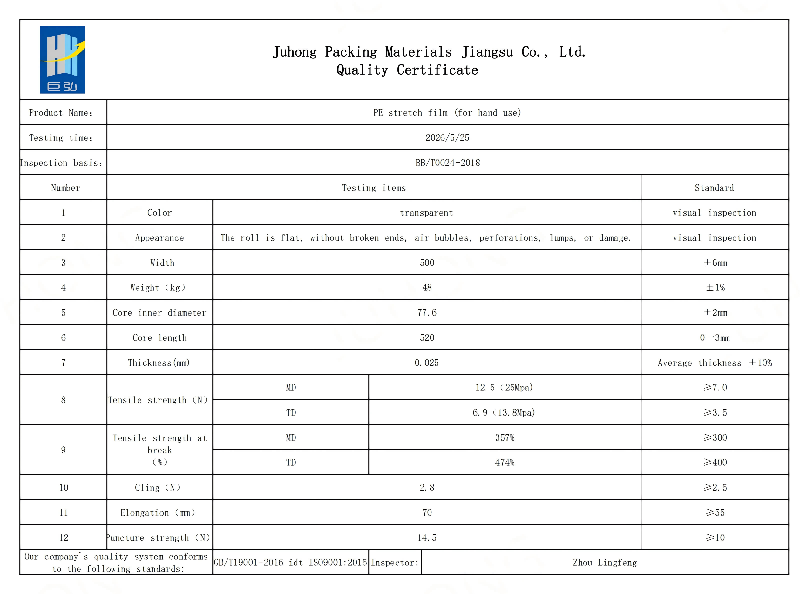
JUHONG Note: We check stretch film quality during and after production using branded raw materials as the starting point. During production, random checks may include roll width, thickness, weight, appearance, and elongation-related performance. Visual inspection also checks for issues such as black spots, air bubbles, perforations, lumps, broken
ends, or roll damage.For example, one JUHONG quality certificate for PE hand stretch film (500 mm width, 25 micron thickness, 48 kg roll weight) recorded inspection items including tensile strength, elongation at break, cling, and puncture strength, based on inspection standard BB/T 0024-2018 and a quality system conforming to GB/T19001-2016 idt ISO9001:2015. For buyers who need additional assurance, we can also support third-party inspection according to the order requirement.
Conclusion
Choosing the right stretch film for different pallet loads starts with understanding the load itself.
A stable carton pallet, a mixed warehouse load, a heavy industrial product, and an irregular sharp-edged pallet all require different wrapping priorities. The best solution is the one that fits the real application, supports stable wrapping, and helps control packaging cost without sacrificing load security.
At JUHONG, we recommend choosing stretch film based on actual pallet load conditions rather than thickness alone, so buyers can improve pallet stability and packaging efficiency in real applications.Ready to test a specific load? Request a free sample before placing a bulk order.
![]() juhong packing materials stretch film Brochure.pdf
juhong packing materials stretch film Brochure.pdf
 简体中文
简体中文