Quick Answer
Before switching PET strapping suppliers, compare the new strap with your current requirements and identify anything that could affect machine operation or load security. Check the samples, test feeding and joining on your equipment, and arrange further package testing where the change could affect handling or transport performance. Before placing a bulk order, agree on the tested specification, shipment checks, and the information needed to trace future deliveries.
A new vendor may offer a better price, more reliable delivery, or help with a recurring problem. The purchasing question is whether its strap can do the job your current operation needs. PET (polyethylene terephthalate) strapping—a polyester also sold as PET banding—is one of the most widely used plastic strapping materials because it combines strength with tension retention on many general cargo and heavy loads, but not every vendor's PET strap is built the same way.
That question is easier to answer when the manufacturer knows what already works, what needs to improve, and which parts of your packaging process will stay the same.
What Will Change When You Replace Your PET Strapping Supplier?

Start by describing the replacement you need. Are you keeping the same equipment and loads, looking for a solution to poor feeding, or changing the strap size and packaging arrangement as well?
A supplier change can involve more than a different name on the quotation. The proposed strap may have different dimensional tolerances, elongation, surface characteristics, or roll winding. Those differences deserve attention even when the quoted width and thickness match.
Some proposals also change the material itself. A vendor may offer polypropylene (PP) strapping instead of PET strapping to lower the price or a PET strap with a different recycled content. PP and PET strapping are not interchangeable: PP straps generally have lower tensile strength and elongation than PET strapping, so the differences between PP and PET straps can affect tool settings, joint strength, and load security even when the width and thickness look similar. PET strapping is often chosen as a lighter, corrosion-free alternative to steel strapping or steel coil banding, while PP is available in standard PP and heavy-duty PP grades that still trade away some of PET's high elongation recovery for a lower price; a strap made from recycled PET (rPET) is a separate material change worth flagging too. If a plastic strap proposal does not clearly state PP or PET, ask before comparing samples.
Send the new source your current specification and an identified sample. Explain the machine or tool you use, how the joint is made, what you pack, and why you want to change suppliers. If the current material sometimes fails, describe when the problem occurs.
For a distributor, collect these details from the end user. A quotation based on incomplete machine information can leave both you and the manufacturer working toward the wrong requirement.
If you are also changing the load or packaging method, choosing the right PET strapping for the application comes before deciding whether a new vendor's sample is an acceptable replacement.
Which Differences Need Checking Before You Accept the Samples?

Compare the existing requirement with the new proposal. Write down any missing information instead of assuming that a matching product description covers it.
| Item to compare | Ask the new supplier | What to check next |
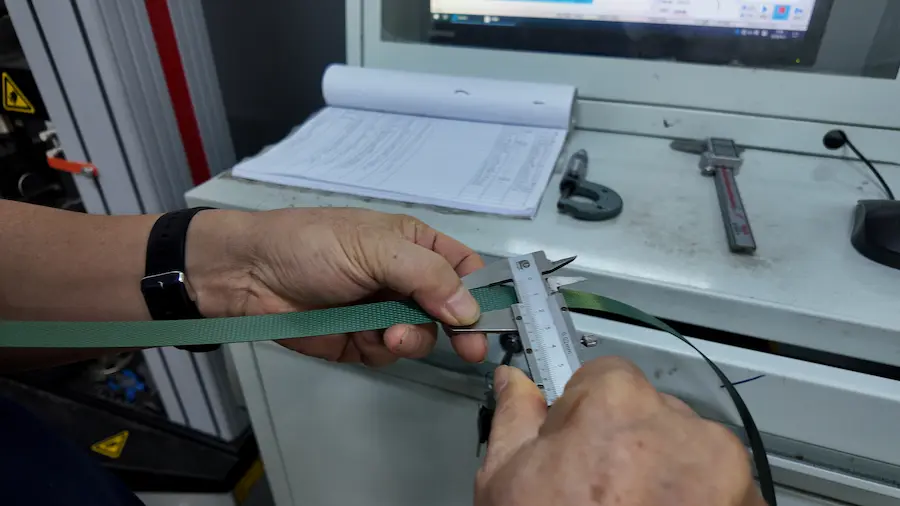
| Dimensions | What width and thickness tolerances will you supply? | Measure identified samples using an agreed method |
| Mechanical properties | What breaking-force, elongation and tension retention will the product meet? | Compare results obtained on a consistent test basis |
| Surface and straightness | What surface finish and camber requirements can you control? | Compare the sample and observe how it travels through the equipment |
| Core and winding | Will the supplied coil fit our dispenser and feed arrangement? | Check core dimensions, coil width, winding and unwinding |
| Joining | Is the proposed material intended for our joining method (heat-seal, friction weld or metal seals)? | Test joints made with the actual strap and equipment, including the strap ends |
| Load and route | Has anything changed in the load, strap arrangement, carton or pallet contact points, or distribution conditions? | Review whether existing packaging results still cover the application |
| Production supply | How will bulk rolls be identified and checked against the approved sample requirements? | Agree on product codes, batch identification and inspection records |
The table is a purchasing checklist. The actual limits should come from your equipment requirements, packaging needs, and agreed product specification.
Check PET strap width, thickness, and roll specifications together. A roll may contain the right strap size but still be unsuitable for the dispenser, so confirm width and tool type before ordering.
Surface differences also need context. A proposal to use smooth or embossed PET strapping should be explained in relation to your equipment and joining method, then checked in a trial.
What Do the Test Results Actually Tell You?

Each check answers a different purchasing question. Use the results together before deciding whether to order.
Sample measurements show how the tested pieces compare with the agreed requirements. They can identify differences in dimensions or mechanical properties. Several measurements from one roll do not establish consistency across several production batches.
Joint testing checks the connection made by your strap, tool, or machine and whether the joint is a heat seal, friction weld, or metal seal. A strap-body breaking-force result does not show how that connection will perform.
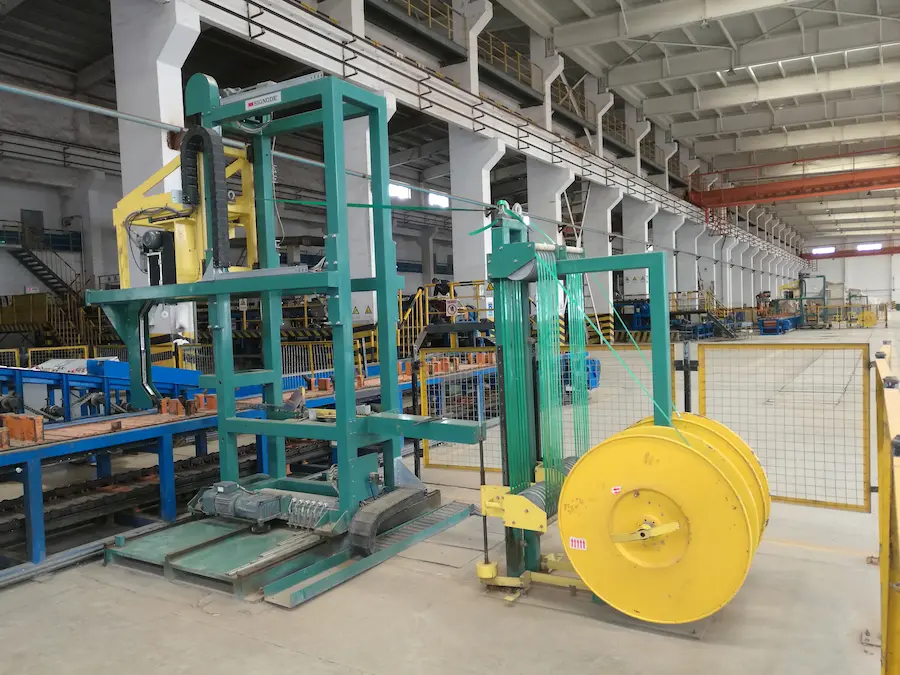
A machine trial shows how the sample feeds, tensions, and joins under the recorded operating conditions on manual, semi-automatic, or fully automatic strapping machines. Watch for intermittent interruptions as well as a complete failure to run.
Checks on the packed load show how the strap interacts with the product, edges, carton, pallet, and other packaging, and under the environmental conditions the shipment will actually face, including UV exposure during transport and storage conditions. Where transport performance is uncertain, additional testing should address the relevant handling or distribution conditions.
For example, a laboratory report may meet the required breaking force while the sample still feeds poorly. The next step is to investigate the feeding problem and trial the proposed correction. Repeating the same tensile test alone will not answer that equipment question.
Keep the units clear when comparing reports. Breaking force in N or kN and tensile strength in MPa describe different quantities. Ask the vendor to explain any differences in test method before comparing numbers directly.
How Much Testing Do You Need Before a Bulk Order?
Choose the testing around the differences you have identified and the questions still unresolved. A nominal specification match is only the starting point for the review.
When the equipment and application stay the same
Compare the proposed product with the current requirements, then verify the relevant material properties, joint performance, and line operation. Keep sample identification and trial conditions in the record.
If these checks leave concerns about load restraint, package damage, or transport performance, investigate those concerns before approving the replacement. Successful feeding is one part of the decision.
When the new sample requires different machine settings
Record the original settings and the changes needed for the sample. Confirm that the resulting operating conditions are acceptable for production and that the joint still meets the agreed requirements.
For automatic strapping machines, provide the machine model when discussing PET strapping for machine use. A manufacturer needs that context when proposing dimensions, surface characteristics, and roll format and should confirm the proposal is machine-grade PET strapping rather than a hand-grade coil.
Equipment adjustments should follow the manufacturer's instructions and the plant's maintenance procedures. Avoid changing the strap, strapping equipment settings, and load arrangement without recording what changed between trials.
When the load or distribution conditions also change
A heavier load, a heavy-duty bundle, different contact edges, revised strap positions, or a new transport route may require broader packaging verification. Give the packaging team or laboratory the actual changes so it can select appropriate tests.
For packaging evaluated under ISTA protocols, ISTA's retesting guidance calls for retesting after product, package, or process changes that may affect performance. It also advises retesting when that effect is uncertain.
The reason for testing should be clear before work starts. “The new roll must feed consistently on this line” and “this revised load must withstand the intended distribution conditions” lead to different checks.
Which Test Methods and Requirements Should You Agree On?
Agree on the applicable methods and acceptance requirements before comparing results. A report needs enough information to show which product was tested and how the result was obtained.
For material and joint requirements, ASTM D3950 covers nonmetallic strapping and joining methods, including PP and PET strap. Its public summary includes breaking strength, elongation, and joint-related requirements where applicable.
For packaged shipping units, ASTM D4169 addresses performance under a sequence of distribution hazards. A shipping-unit evaluation answers a broader question than a strap material test.
These references do not select the procedure for every PET supplier change. Your customer contract, packaging application, equipment requirements, and intended distribution conditions still need to be considered.
Before testing, agree on:
The sample or batch being evaluated.
The property or packaging behavior to be checked.
The test method and any relevant conditioning.
The result required for acceptance.
Who reviews the results and decides whether further work is needed?
Where a certificate or approval is required, check that it applies to the product being offered. A general company certificate does not demonstrate that every strap specification or packaging arrangement meets your requirements.
JUHONG's role is to support the material specification, samples, and product information. The customer's technical team and any appointed laboratory should agree on the application-specific testing and acceptance requirements.
Can One Successful Trial Cover All Your Lines and Customers?
A successful trial should stay linked to the equipment, load, and conditions it actually covered.
If you use the strap on several machines, list the differences that could affect the result: joining method, accepted dimensions, dispenser format, and operating settings. If you supply several factories, include differences in their loads and packaging arrangements.
The heaviest load is not always the only useful test case. A lighter product with vulnerable edges may raise a different concern from a heavy, rigid bundle. Likewise, a successful trial on one joining system does not automatically cover another.
Agree with the responsible technical team on which combinations the trial can reasonably represent and which need separate checks. Record that decision so purchasing knows where the new material can be used.
After the trial, record which strap was tested, on which machine, and for which load. Use these details to confirm the specification with your vendor before placing the bulk order.
How We Helped an Overseas Aluminum Ingot Producer

In March 2026, a large overseas aluminum ingot producer contacted us about a recurring problem: its PET strap kept jamming instead of feeding smoothly. The customer had tried several vendors, but only one strap worked well on its equipment. They wanted our help finding a replacement that would run reliably.
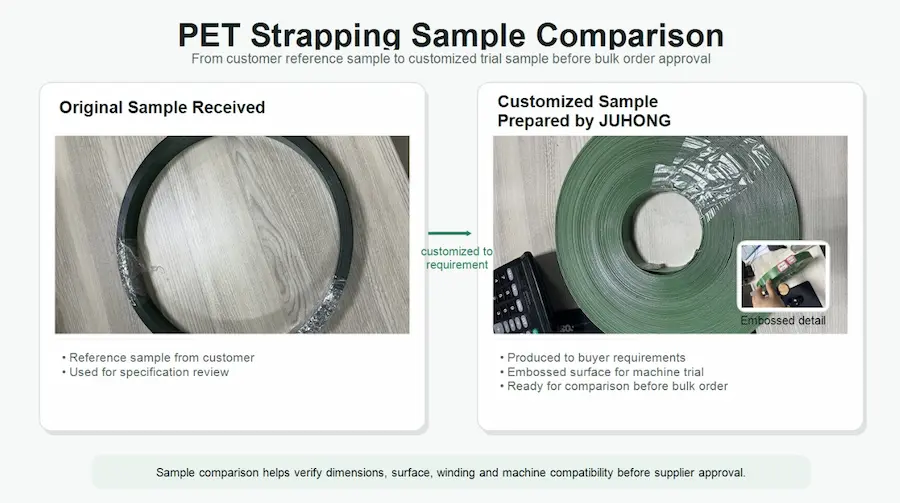
They sent us two samples by courier: the strap that caused problems and the one that worked. As soon as the samples arrived, our technicians tested them, recorded the measurements, and met to discuss what we could improve.
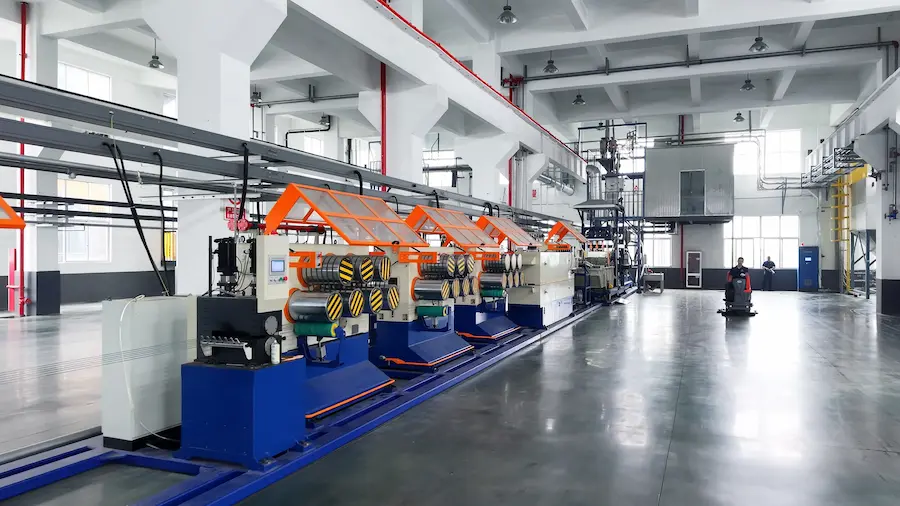
About a month later, the customer visited our factory to see our PET strapping production line. We went through the results together and discussed a customized strap for their machine.
We used the working sample as our reference. We proposed controlling how straight the strap would be, its width and thickness tolerances, and the depth of the embossing. We also took their heat-knife joining system and how the strap ends were sealed into account. Before sending samples for a machine trial, we proposed checking the dimensions, breaking force, and elongation at our factory.
The customer later told us that our customized sample ran without problems on their machine. They are now preparing to place a formal order.
What Should You Confirm for the First Bulk Delivery?
Once the sample works well, confirm how the manufacturer will make and check the rolls in your order. Keep the tested sample reference and agreed specifications with the purchase documents.
| Before you order | What to agree with the supplier |
| Which sample are we ordering? | Identify the sample that passed the trial and keep reference material where practical |
| What must the product meet? | Record dimensions, tolerances, mechanical requirements, surface and roll format |
| What will be checked before shipment? | Agree on inspections, test methods and the records you need |
| How will the rolls be identified? | Connect product labels and inspection records with the production batch |
| What happens if something changes? | Agree which material, process, specification or roll format changes need your review |
| What if the delivery does not meet the order? | Agree how to report the issue and identify, hold and resolve the affected supply |
Check the first shipment in use
When the goods arrive, compare the labels, roll format, and agreed inspection records with the order. Where practical, check the first delivery on the intended production line before introducing it across all equipment or customer sites.
Record any feeding interruptions, joint problems, strap damage or load movement, and the load weight or bundle type involved. Include how much material was used or how many packages were checked; a complaint count without that context is difficult to interpret.
If a problem appears, keep the affected roll identification and describe where it occurred. This gives the manufacturer a starting point for investigation.
Use the same records when comparing cost. Price per roll can be misleading if usable length or net strap weight differs. Compare PET costs and total cost of ownership against the agreed specification, then use actual operating records to assess waste and interruptions.
What Should You Ask the New Supplier to Do Next?
Ask for a sample proposal based on your current material, equipment, and reason for changing suppliers.
For a performance complaint, send a working reference and a problem sample if both are available. Include machine details and a short description or video showing where the problem occurs. This is more useful than asking the vendor to make a generally “better” strap.
The vendor's response should explain what it found, what it proposes to change, which checks it will complete, and what feedback it needs from your trial. Your team should then confirm whether the proposed material meets the agreed operating and packaging requirements.
JUHONG supplies PET strapping for industrial packaging and can discuss sample comparison and customization for your application, whether you need a standard PET strapping solution or a strapping guide for a new packaging line.
Contact JUHONG to review your PET strapping requirements. Send your existing specification, equipment details, and the problem you want the new supply to solve before arranging samples or a bulk order.
Frequently Asked Questions
How do you choose the right PET strapping supplier?
Compare the new vendor's PET strap against your current specification, then verify the material properties, joint performance, and machine feeding on a real trial before ordering. Confirm dimensions and tolerances, mechanical properties, surface and winding, joining compatibility, and how bulk rolls will be identified and inspected. A supplier that helps you compare samples and explains its proposed specification, rather than promising a generally "better" strap, is easier to work with when something needs adjusting.
Do I need a full transport test every time I change PET suppliers?
The required work depends on what changes and which packaging requirements apply. Review material differences, joint performance, machine operation, and any effect on the load or route. Where an applicable procedure calls for retesting, or a performance concern remains unresolved, arrange the necessary testing before release.
Can I approve a replacement with the same dimensions and breaking force?
Those figures provide only part of the comparison. Confirm tolerances, elongation, surface, roll format, and joining compatibility, then evaluate the relevant performance on your equipment and loads.
What if the new strap only works after adjusting the machine?
Record the adjustments and have the technical team confirm that the settings and resulting joint performance are acceptable. Keep those conditions with the sample approval so operators know how the tested result was achieved.
How many rolls should I test before placing a bulk order?
Agree on a trial plan that reflects the machines, loads, and operating variation you need to cover. There is no single roll count for every application. Several measurements from one roll and checks across different rolls or batches provide different information.
What records should I keep after the sample passes?
Keep the sample identity, agreed specification, test results, machine settings, approved applications, and order requirements. Retain the first-delivery inspection and operating records so later issues can be traced.
What technical support should a PET manufacturer provide before ordering?
The manufacturer should help compare your samples, explain the proposed specification, identify any customization needed, and agree on feedback from your trial. Specific recommendations based on the application are more useful than a general promise of improved quality.
PET vs. PP Strapping: Are They the Same?
No. PET and PP strap are both plastic strapping materials, but pet strapping generally offer higher tensile strength, better elongation recovery, and strength comparable to steel strapping on many applications, while PP strapping is lighter-duty and lower cost. If a vendor proposes PP as a substitute for PET, treat it as a material change and test it accordingly rather than assuming it is a drop-in replacement.
Technical References
The public pages below explain the scope of the cited guidance. The applicable test details should be agreed upon for the actual product and shipment.
![]() juhong-pet-strapping-brochure.pdf
juhong-pet-strapping-brochure.pdf
 简体中文
简体中文