Quick Answer
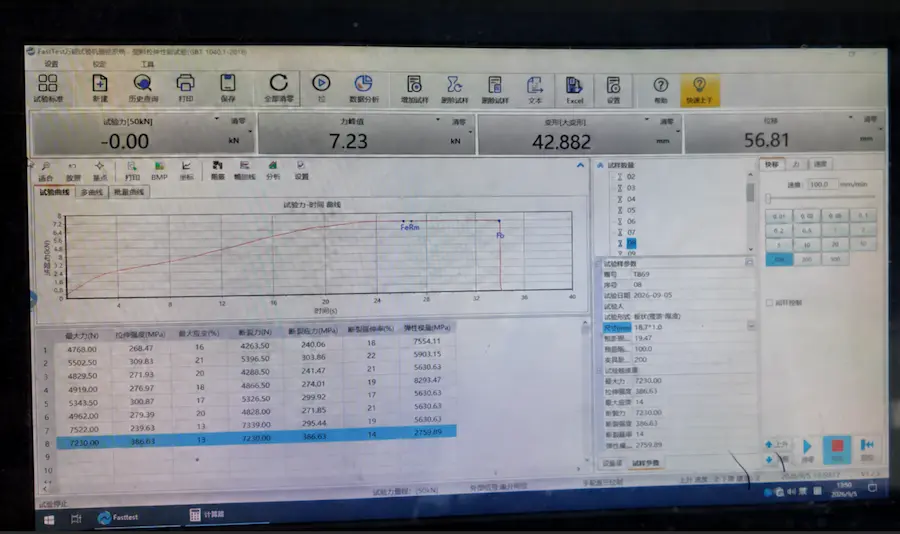
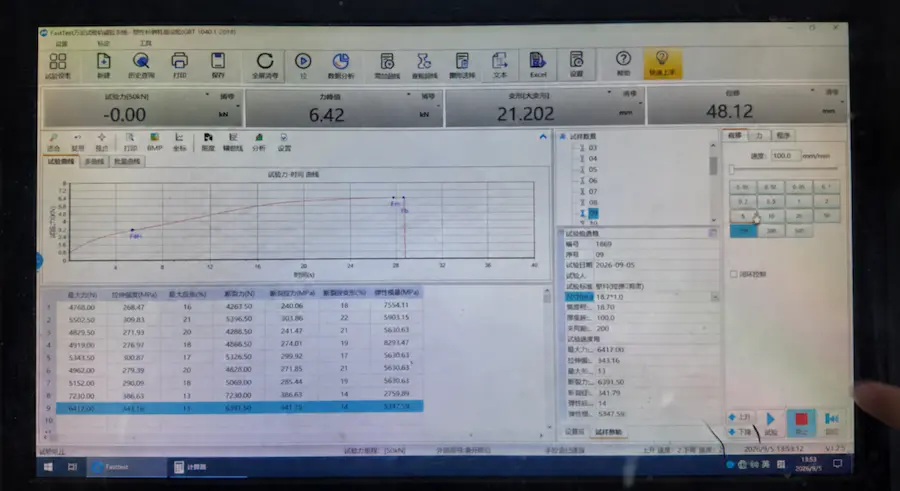
The primary difference between smooth and embossed PET strapping lies in surface texture, strap-body tensile strength and application suitability. In a JUHONG laboratory comparison of 18.7 mm × 1.0 mm samples at 13% recorded maximum strain, the smooth PET strap reached 7,230 N, approximately 12.7% higher than the embossed sample at 6,417 N. This makes smooth PET strapping a strong option for high-tension, heavy-duty industrial loads and compatible automatic packaging machines. Embossed PET strapping offers a more tactile surface, lower net roll weight and better cost efficiency, making it a practical choice for manual or battery-powered tools, timber, bricks and general palletizing.
| If your priority is… | Start by testing… | What must still be confirmed |
| Maximum strap-body breaking force | Smooth PET strapping | Width, thickness, elongation and joint strength |
| Familiar handling with manual or battery tools | Embossed PET strapping | Tool grip, sealing quality and required breaking force |
| Stable use on an automatic line | The surface recommended for that machine | Feeding, core size, camber, welding and repeated-cycle performance |
| Lower purchase price at the same size, breaking-force requirement and roll length | Embossed PET strapping | Actual test result, net weight and operating performance |
| A solution to strap slipping | Do not change surface first | Tension wheel, anti-slip plate, machine gap, settings and strap size |
JUHONG manufactures PET strapping in smooth and embossed finishes. Based on our production, laboratory testing and customer troubleshooting experience, this guide explains how the two surfaces differ and what industrial buyers should verify before placing an order.
What Is Smooth PET Strapping?

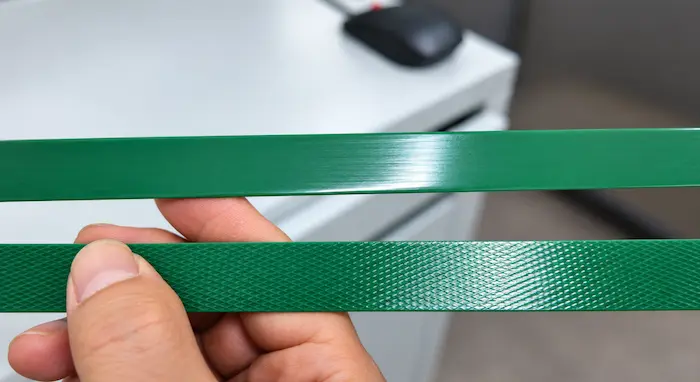
Smooth PET strapping is polyester strapping with a flat, non-embossed surface. It does not show the raised and recessed pattern found on embossed strap.
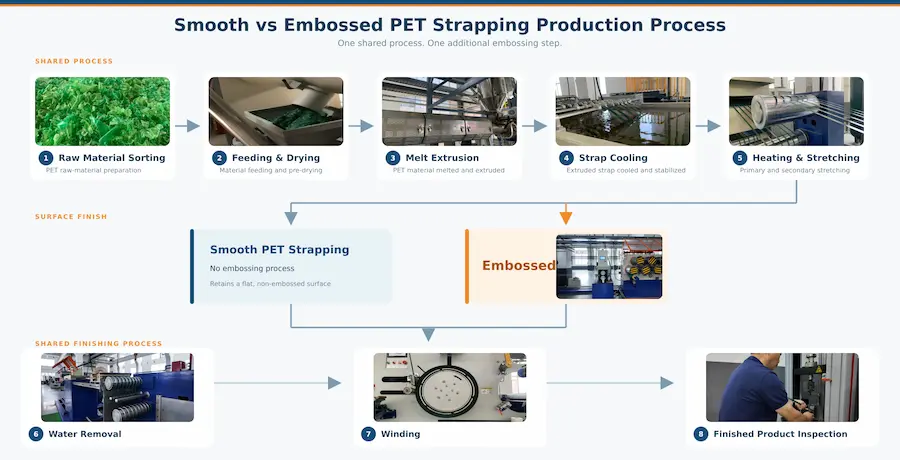
It is produced through a controlled process that includes raw material sorting, feeding, pre-crystallization and drying, melt extrusion, cooling, heating and stretching, heat setting, cooling and setting, water removal, winding and finished-product inspection. During the surface-treatment stage, it remains non-embossed, giving it a flatter and more uniform profile.
A smooth appearance should not be treated as proof of either high strength or poor grip. Its performance depends on the raw material, drying conditions, stretching ratio, heat setting, dimensional tolerances, winding quality and compatibility with the tool or machine.
Main Characteristics of Smooth PET Strapping
| Characteristic | Practical meaning for buyers |
| Flat, non-embossed surface | Easy to distinguish from textured strap |
| Uniform surface profile | Can support consistent feeding when the full machine-grade specification is controlled |
| Clear printing surface | Often suitable when printed identification is required |
| No embossed peaks or recesses | Thickness must still be measured using an agreed method |
| Potentially higher body strength in like-for-like tests | Must be verified using actual test data, not appearance |
Smooth PET strapping is often considered for controlled packaging lines, heavy-duty loads and applications in which stable dimensions and body breaking force are priorities. It can also be used with manual or battery tools when the strap and tool have been tested together.
For automatic applications, surface finish is only one variable. A machine-grade polyester strapping specification should also define width, thickness, camber, core size, coil winding, breaking force and elongation.
What Is Embossed PET Strapping?

Embossed PET strapping is polyester strapping with a textured pattern pressed into its surface. It follows the same main material preparation, extrusion, stretching and stabilization stages as smooth PET strap, but an embossing step is added during surface treatment.
The visible pattern can provide a more tactile handling feel and may change surface interaction with some tools, seals or loads. Embossed green PET strap is widely recognized in manual, pneumatic and battery-tool packaging, but embossing itself is not the source of the strap’s tensile strength.
The important quality checks are pattern consistency, width and thickness tolerance, breaking force, elongation, winding and joint performance. A pronounced pattern does not compensate for poor material or unstable production control.
Main Characteristics of Embossed PET Strapping
| Characteristic | Practical meaning for buyers |
| Textured surface | More tactile during handling |
| Visible embossed pattern | Easy to identify in the warehouse |
| Common in manual applications | Often used with manual, pneumatic and battery-powered PET tools |
| Different surface profile | Thickness and meter yield must be compared using an agreed basis |
| Pattern depth varies by specification | Sample approval is more reliable than judging a close-up photograph |
Embossed PET strapping is commonly considered for cartons, timber, bricks, blocks, mixed pallets and general warehouse packaging. For manual PET strapping, buyers should confirm the tool range, tensioning performance and joining method before approving the surface.
Smooth vs Embossed PET Strapping: Key Differences
| Factor | Smooth PET strapping | Embossed PET strapping | Buyer guidance |
| Surface | Flat and non-embossed | Textured with a visible pattern | Specify the finish in the PO |
| Strap-body strength | May be higher in some controlled, same-size comparisons | Can meet many industrial packaging requirements | Compare test reports under the same conditions |
| Handling | Flatter feel | More tactile feel | Let operators test both when handling matters |
| Grip | Depends on tool pressure, load contact and surface condition | Texture may affect friction in some systems | Do not use surface as the only anti-slip measure |
| Machine use | Can perform well on compatible automatic lines | Can also run on machines designed for it | Test the actual machine and settings |
| Printing | Usually provides a flatter printing area | Pattern may affect print definition | Request printed samples if identification matters |
| Thickness comparison | Usually easier to define by a flat profile | Peaks and recesses can complicate comparison | Agree on the measurement method and tolerance |
| Roll yield | Depends on dimensions, density and winding | Surface profile may affect meters per kilogram | Confirm actual meters and net roll weight |
| Price | Usually slightly higher in a like-for-like quotation | Usually slightly lower at the same nominal size, required breaking force | Compare identical requirements and approved samples |
| Typical selection logic | Strength-focused or controlled lines | Manual handling, general industrial use and cost-sensitive orders | Application and trial results should decide |
This table is a screening tool, not a final approval standard. Two straps with different surfaces may both work, and two straps with the same surface may perform very differently if their material, dimensions or production control are different.
Does Surface Finish Affect Breaking Force?


Surface finish can affect the strap’s cross-sectional profile, but it is only one of several variables that influence breaking force. Width, actual thickness, raw material, molecular orientation during stretching, heat setting and test conditions all matter.
In a JUHONG internal comparison, smooth and embossed samples were checked at the same nominal size of 18.7 mm × 1.0 mm and a recorded maximum strain of 13%. The results were:
| Sample | Maximum force | Tensile strength |
| Smooth PET strapping | 7,230 N | 386 MPa |
| Embossed PET strapping | 6,417 N | 343 MPa |
The smooth sample produced the higher strap-body result in this comparison. This supports a limited, practical conclusion: when material, nominal dimensions and test conditions are closely controlled, a smooth strap can retain more body breaking performance than an embossed version. It does not prove that every smooth PET strap is stronger than every embossed PET strap.
Buyers should avoid comparing a smooth sample from one supplier with an embossed sample from another and attributing the entire difference to surface finish. Ask whether:
The samples use comparable PET material.
Width and thickness were measured using the same method.
The same tensile tester, gauge length and test speed were used.
Samples were conditioned and selected consistently.
The reported result is strap-body strength or joint strength.
ISO 527-1:2019 sets out general principles for determining tensile properties of plastics under defined conditions. For nonmetallic strapping and joining methods, ASTM D3950-23 is the more directly relevant purchasing reference. The exact test method and acceptance criteria should be agreed between buyer and supplier.
How the Production Process Creates the Surface Difference

Smooth and embossed PET strapping share most production stages. The difference appears at the surface-treatment stage.
| Production stage | Smooth PET strapping | Embossed PET strapping | Why it matters |
| Raw material sorting | Same main purpose | Same main purpose | Removes unsuitable material and supports batch consistency |
| Feeding | Controlled feeding | Controlled feeding | Stabilizes the process |
| Pre-crystallization and drying | Required | Required | Excess moisture can reduce material performance during processing |
| Melt extrusion | Forms the strap blank | Forms the strap blank | Influences dimensional consistency |
| Cooling | Cools the extruded strap | Cools the extruded strap | Prepares it for controlled stretching |
| Heating and primary/secondary stretching | Orients the PET material | Orients the PET material | A major contributor to body strength and elongation behavior |
| Surface treatment | Strap remains smooth | Embossing rollers form the pattern | Creates the visible surface difference |
| Heat setting | Stabilizes the stretched strap | Stabilizes the stretched, embossed strap | Supports dimensional and performance stability |
| Cooling, water removal and winding | Completed to specification | Completed to specification | Affects coil shape, feeding and storage |
| Finished-product inspection | Dimensions and performance checked | Dimensions, pattern and performance checked | Confirms the batch against the agreed specification |
In factory troubleshooting, the embossing pattern is easy to see, but the less visible stages—especially drying, stretching and heat setting—often explain more of the difference in body performance. When two rolls with the same label behave differently, the investigation should include raw material batch, dimensional records, stretching stability, heat-setting conditions, winding tension and test data.
Does Embossed PET Strapping Provide Better Grip?
Embossing changes the surface texture and may affect friction or tool contact in some packaging systems. However, it should not be described as a guaranteed anti-slip solution.
PET strap can slip during tensioning because of:
A worn or dirty tension wheel
An excessive machine tightening gap
A dirty or damaged anti-slip plate
Incorrect tool pressure or tension settings
Strap thickness outside the tool’s working range
Poor strap alignment
A worn welding head
Dust, oil or moisture on the load surface
A Real Troubleshooting Case
Troubleshooting Case: The PET Strap Was Not the Root Cause
For a similar complaint, use the following checks:
Mark the strap before tensioning.
Apply the normal tool or machine setting.
Observe whether movement occurs at the tension wheel, load surface or joint.
Inspect the tension wheel, anti-slip plate and welding head.
Check whether the strap dimensions match the tool range.
Repeat the trial with both surfaces under the same settings.
Joint Strength Matters as Much as Strap-Body Strength
A high strap-body breaking force does not guarantee a secure package if the joint is weak. PET strapping may be joined by friction welding, heat sealing, metal seals or compatible buckles, depending on the packaging system.
When comparing smooth and embossed PET strapping, test:
Strap-body breaking force
Weld or seal joint strength
Slip behavior during tensioning
Break location
Weld appearance
Repeat-cycle consistency
If the strap breaks away from the joint, review body strength, edge damage and applied tension. If the weld opens, review welding time, pressure, cooling time, tool wear and strap compatibility. If the strap slips before welding, inspect the tensioning components first.
When metal seals are used, the strapping seal width, serration, material and crimping tool must match the PET strap. Buyers should approve the strap and joining method as one system.
Machine Compatibility: Do Not Choose by Surface Alone
Some automatic lines run smoothly with non-embossed PET strap; others are designed or adjusted for embossed material. Manual, pneumatic and battery tools also have defined width and thickness ranges. The only reliable decision comes from testing the actual strap on the actual equipment.
Before requesting a sample, send the supplier:
Machine or tool brand and model
Accepted strap width and thickness range
Required breaking force
Joining method
Core inner diameter and coil width
Current tension and welding settings, if available
A photo or video of the existing strap path and packaging process
During a machine trial, record feeding stability, tension, welding time, cooling time, joint appearance and any dust, shaving or melted residue. Do not approve a material after only one successful cycle; run enough repeated cycles to reveal intermittent feeding or welding problems.
Thickness, Roll Length and the Real Cost Comparison
Roll price alone is a poor comparison. Surface profile, actual thickness, net roll weight and winding all influence the usable length of a PET strapping roll.
Embossed material has peaks and recesses, so suppliers and buyers may not interpret a nominal thickness in exactly the same way. The quotation or specification should state how thickness is measured and what tolerance applies.
Price is also a practical reason why some buyers choose embossed PET strapping. In JUHONG quotations, when the nominal size, required breaking force and roll length are the same, embossed PET strapping is usually slightly cheaper than the smooth version. This price difference should still be evaluated on a true like-for-like basis: both offers must meet the same tensile requirement, dimensional tolerance, usable length, winding quality and sample-approval standard.
Use this basic calculation:
Cost per meter = Roll price ÷ Actual meters per roll
For a purchasing decision, also compare:
| Cost factor | Why it matters |
| Actual meters per roll | Determines usable output |
| Net strap weight | Helps verify material quantity |
| Breaking force and joint strength | Confirms whether the strap meets the load requirement |
| Failed welds or re-strapping | Adds material and labor cost |
| Machine stoppages | Reduces packaging-line efficiency |
| Roll change frequency | Matters on high-volume automatic lines |
| Pallets successfully packed per roll | Shows the most useful operational cost |
A lower roll price does not create a saving if the roll contains fewer usable meters or causes more feeding and sealing failures. When both surfaces pass the technical trial, compare cost per successfully packed pallet rather than price per roll.
How to Choose Smooth or Embossed PET Strapping
Quick Decision Guide
Use this sequence to narrow down the correct surface without treating it as an isolated choice:
Is maximum strap-body breaking force the main priority?
Test smooth PET strapping first, then verify its actual width, thickness, elongation and joint strength.
Do you use manual, pneumatic or battery-powered tools for general palletizing?
Include embossed PET strapping in the trial and evaluate handling, tensioning, sealing and tool compatibility.
Must both options meet the same nominal size, breaking-force requirement and roll length?
Embossed PET strapping is usually slightly cheaper, but confirm that both samples meet the same performance and quality requirements.
Is the strap slipping during tensioning or welding?
Do not change the surface immediately. Inspect the tension wheel, tightening gap, anti-slip plate, welding head, strap dimensions and machine settings first.
Do both surfaces pass the technical trial?
Choose the option with more consistent quality, more reliable supply and the lower cost per successfully packed pallet.
Choose Smooth PET Strapping When
Controlled testing shows that body breaking force is the main priority.
The existing automatic or semi-automatic line runs it consistently.
A flatter surface is preferred for printing or identification.
The supplier can maintain the required width, thickness, camber and winding quality.
A heavy-duty application has passed both body and joint testing with the smooth sample.
For steel coils, aluminum ingots and other dense industrial loads, start with the required breaking force, number of straps, joint efficiency and edge protection. Smooth strap can be included in the first trial when maximum body strength is a priority, but the load-securing design must determine final approval.
Choose Embossed PET Strapping When
Operators prefer a more tactile surface.
Manual, pneumatic or battery-powered tools are used successfully with it.
The application involves cartons, timber, bricks, blocks or mixed industrial pallets.
The required breaking force and joint performance are already satisfied.
The same nominal size, required breaking force and roll length can be supplied at a slightly lower price than the smooth option.
The embossed sample provides the better verified operating cost after testing.
Either Surface May Work When
Many regular palletizing applications can use either surface if the strap size, strength, joint and equipment match. If both samples pass repeated testing, select the option with the more stable supply, consistent quality and lower total operating cost.
Sample Approval Checklist for Buyers
Before placing a bulk order, compare both samples under the same conditions.
Record surface finish, width, thickness, color, core size, roll length and net roll weight.
Confirm breaking force, elongation and the agreed test method.
Run both straps on the actual tool or machine.
Pack the real load using the same tension and joining settings.
Inspect feeding, slipping, strap edges and the joint.
Allow settling time if the load compresses or changes shape.
Repeat the test across multiple packages.
Record the approved sample, machine model and settings.
Recommended purchase-order wording:
PET strapping surface finish to match the approved sample. Supplier shall maintain the approved width, thickness and tolerance, breaking force, elongation, roll length, net weight, core size, color, winding and packing method. Material must be compatible with the buyer’s confirmed equipment and joining method.
Conclusion
Smooth and embossed PET strapping are two surface finishes of the same packaging material, but they should not be selected by appearance alone. Smooth strap may retain higher body breaking performance in some controlled comparisons. Embossed strap offers a recognizable, tactile surface and works well in many manual and general industrial applications.
The better choice is the strap that meets the required breaking force, maintains a reliable joint, runs consistently on the buyer’s equipment and delivers the lower verified packaging cost.
If you are evaluating a new PET strapping specification, send JUHONG your load type, current strap size, required breaking force, equipment model, joining method and preferred roll format. Our team can recommend a sample for testing before bulk production. Contact JUHONG for specification support.
Frequently Asked Questions
1.Is smooth PET strapping stronger than embossed PET strapping?
Not in every case. In JUHONG’s controlled comparison of 18.7 mm × 1.0 mm samples at 13% recorded maximum strain, the smooth sample reached 7,230 N and the embossed sample reached 6,417 N. Material, actual dimensions, production settings and test conditions must be comparable before attributing the difference to surface finish.
2.Does embossed PET strapping have better grip?
Its textured surface may affect friction and handling in some packaging systems, but embossing does not guarantee that the strap will not slip. Tool condition, tension-wheel contact, strap thickness, settings and the load surface must also be checked.
3.Which surface is better for automatic strapping machines?
Use the surface that passes repeated tests on the actual machine. Smooth PET strap can provide stable feeding on compatible lines, while some machines also run embossed strap successfully. Confirm dimensions, camber, core size, winding, feeding and welding performance.
4.Which PET strapping is better for heavy-duty loads?
Choose by required breaking force, joint efficiency, strap size, number of straps, edge protection and transport conditions first. When maximum strap-body strength is a priority, include smooth PET strapping in the sample comparison.
5.Why does PET strapping slip during tensioning?
Common causes include a worn tension wheel, excessive tightening gap, dirty anti-slip plate, incorrect tool settings, unsuitable strap thickness or poor alignment. Identify where the movement occurs before changing the surface finish.
6.Which type provides more meters per roll?
It depends on width, actual thickness, surface profile, net strap weight and winding. Ask the supplier to state the actual roll length and measurement basis, then compare cost per meter and cost per successfully packed pallet.
7.What should a PET strapping purchase specification include?
Include surface finish, width, thickness and tolerance, minimum breaking force, elongation if required, roll length, net roll weight, core size, color, winding, equipment model, joining method, packing and approved-sample reference.
![]() juhong-pet-strapping-brochure.pdf
juhong-pet-strapping-brochure.pdf
 简体中文
简体中文