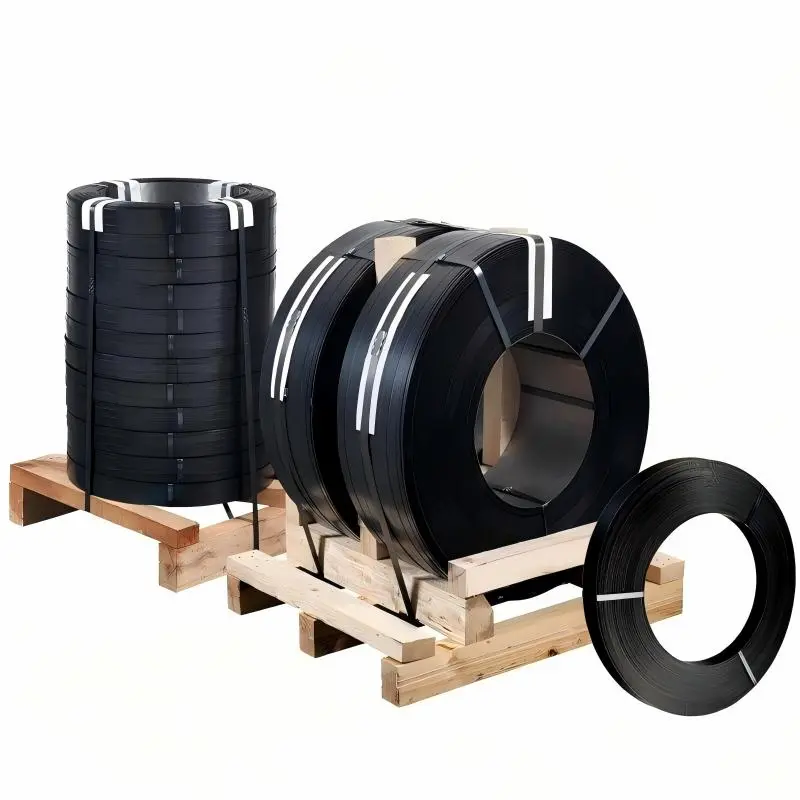
The three most common types of strapping used in industrial packaging are steel, PET (polyester) and PP (polypropylene). Steel suits rigid, demanding loads where resistance to stretching matters. PET is a common choice for palletized goods that need strength and some elastic recovery during handling. PP works well for cartons, light bundles and applications with lower holding-force requirements.
At JUHONG, we manufacture steel, PET and PP strapping. To choose between them, we start with what you are packing. Does the load stay rigid, or does it settle? Will the strap touch a sharp edge? Which tool or machine will apply it? Those details help us narrow down the material before discussing width, thickness and strength.
Key Takeaways
Steel strapping is a strong candidate for rigid metal bundles and demanding industrial loads, but it has limited ability to take up slack when a package shrinks.
PET strapping can replace steel in suitable applications after the strap, joint and complete package have been validated. Matching strap width alone is insufficient.
PP strapping is suitable for many cartons and light bundles. Applications that need sustained holding force deserve a closer comparison with PET.
Single-strap break strength, joint strength and load capacity are different measurements. Buy against a defined strap specification and an approved packaging method.
What Is Strapping, and Is It the Same as Banding?
Packaging strapping is a narrow metal or plastic band tensioned around a carton, bundle or palletized load and joined into a loop. It helps hold the package together during storage and handling. The banding material and the way it is joined both affect the result.
Strapping vs Banding: Two Names for the Same Product
In packaging, strapping and banding usually describe the same product or operation. “Steel banding” commonly means steel strapping; “plastic banding” may mean PET or PP strapping.
The terminology becomes less useful outside packaging. A reusable ratchet tie-down, a lifting sling and a packaging strap perform different jobs. This guide covers packaging straps used for bundling and unitizing goods. Securing that package to a vehicle requires its own suitable restraint arrangement.
What "Poly Strapping" Means: PP or PET?
“Poly strapping” is an ambiguous purchasing term. Depending on the supplier, it may mean polypropylene or polyester. We need the polymer name to identify the product.
If you ask us for “16 mm poly strap,” we still need to know whether you mean PP (polypropylene) or PET (polyester). Write the material name on your inquiry, together with thickness, required break strength and the tool or machine model. That lets us discuss the right product without guessing from the word “poly.”
The Main Types of Strapping Materials
We make steel, PET and PP strapping for different packaging jobs. Here is how we compare them, including the point at which we would consider another material.
Steel Strapping

Steel strapping is metal banding used where a stiff strap and high restraint force are needed. It is commonly considered for metal products and other rigid bundles. Its low elastic stretch helps limit movement, although the strap can become loose if the package beneath it settles or shrinks.
We manufacture steel strapping in widths of 12.7–50 mm. Our range includes thicknesses of 0.38–1.20 mm and tensile strengths of 650–1,000 N/mm², depending on the grade and size. The available combinations vary, so we need the grade, width and thickness together to identify a suitable specification.
Steel Strapping Grades and Finishes

We distinguish regular-duty and high-tensile steel strapping by their mechanical properties, including tensile strength and elongation. High tensile strength alone does not establish the capacity of a finished package. When comparing grades, keep the width, thickness and joint in view. A higher tensile-strength figure may allow a different strap size, but the proposed size still needs to hold the package securely with the selected joint.
We offer bright, blue-tempered and waxed, painted and waxed, and galvanized finishes. For storage and shipping, tell us where the strap will be exposed to moisture and whether rust marks would damage the goods. The finish needs to suit that exposure; its color does not tell you the steel's strength. Our steel strapping selection guide explains the grade and finish choices.
Where Steel Strapping Is the Right Choice
For heavy-duty applications such as rigid metal bundles and pipe, we recommend considering steel first, especially where the existing packaging specification requires it. Before discussing a switch to plastic, we would need to understand sharp contact points, product temperature and any outward force from the load.
Steel still needs a suitable strap path, joint and edge protection where required. Its strength does not prevent the band from marking a finished surface or a poorly formed joint from failing.
PET (Polyester) Strapping
(1)")
PET strapping is an extruded plastic band made from polyethylene terephthalate. It combines tensile strength with elastic recovery, which can help it maintain contact with a package as the load moves or settles. PET is widely used for palletizing and industrial bundling.
We manufacture PET strapping in widths of 9–32 mm, with thicknesses of 0.5–1.4 mm across the range. If you are buying 16 mm PET, width is only part of the specification: our 16 mm options span several thicknesses and break-force levels. Include the required minimum break force when comparing quotations.
| PET strap width | Available thickness range | Break-force range across specifications |
| 9 mm | 0.5–0.8 mm | 1,540–3,550 N |
| 16 mm | 0.5–1.2 mm | 2,200–9,400 N |
| 19 mm | 0.8–1.4 mm | 4,170–13,030 N |
| 32 / 31.75 mm | 0.8–1.4 mm | 8,710–21,950 N |
Each row covers several specifications. Use the minimum break force for the exact width and thickness you order; the highest figure in a row does not apply to every strap in that row.
Smooth vs Embossed, Hand Grade vs Machine Grade

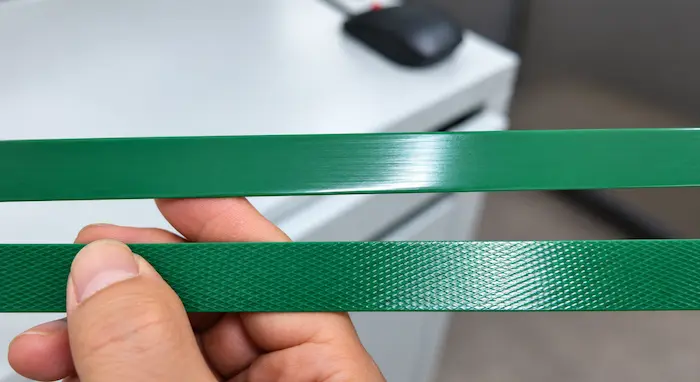
Smooth PET has a flat surface; embossed PET has a textured pattern. Choose the surface your feeding, tensioning and sealing equipment is designed to handle. Two straps with the same nominal width and thickness can have different break-force specifications, so texture alone will not tell you which one is stronger.
For automated strapping, we also look at dimensional consistency, straightness and coil winding. A strap that works with a hand tensioner may still feed poorly on an automatic line. Run the sample through your actual machine before approving the bulk specification.
Where PET Strapping Is the Right Choice
We recommend evaluating PET for palletized building materials, timber and paper products, particularly when the package settles slightly after strapping. PET's recovery can help it maintain tension as the load settles, and the strap itself avoids leaving rust stains.
Exposed sharp edges or hot surfaces may make PET unsuitable even when its break force looks sufficient. Our PET strapping selection guide explains how to assess the load, equipment and shipping conditions together.
PP (Polypropylene) Strapping

PP strapping is a lightweight plastic band commonly used for cartons, printed products and light bundles. It can be economical when the package needs bundling or closure with relatively low sustained tension.
We supply PP strapping in nominal sizes from 5–18 mm. When comparing strength, we separate the unjoined strap from the sealed joint. The seal depends on the machine or closure used, so a high single-strap rating does not tell you how much force the finished joint will hold.
Please state your required minimum force in newtons or pounds-force and whether you need a strap result, a joint result or both. This gives us a clear basis for comparing specifications. You can see the range on our PP strapping product page.
Hand Grade vs Machine Grade PP
For hand-applied PP, we need to match the strap to the buckle or sealing tool. For machine use, the reel must also fit the dispenser and feed consistently. Send us the core dimensions and coil width as well as the strap size; a reel can be the right strap width and still fail to fit your machine.
A change from PP to PET may require different equipment or settings. Confirm the machine's approved materials before buying a trial batch.
Where PP Strapping Is the Right Choice
We recommend PP for closed cartons and light bundles when only modest holding force is needed. If the strap has to keep a pallet tightly contained through extended storage, we would compare PET before increasing the PP size or adding more bands.
Increasing the initial tension is not a reliable remedy for straps that later become loose. It may damage the carton before addressing the underlying material or package-design problem.
Woven, Composite and Corded Strapping
You may also be offered woven or composite strapping for irregular bundles. Woven strap is made from interlaced yarns; composite strap has yarns inside a protective polymer coating. Both differ from the solid PET band we manufacture, even though polyester may be used in each.
The practical difference is the joining system. If you are replacing a woven or composite strap with PET, the existing buckle may not grip the new strap correctly. Ask for the full material and closure specification when a quotation only says “corded strap.” We do not manufacture woven, composite or corded strapping. Paper and polyethylene straps are also available for specific packaging applications, but they need their own material and equipment checks.
Steel vs Plastic Strapping: PET (Polyester) and PP (Polypropylene)
We use the following distinctions to narrow down the material. Once you have a likely choice, compare the exact strap size and joint needed for your package.
| Selection factor | Steel strapping | PET strapping | PP strapping |
| Common starting applications | Rigid metal bundles and demanding industrial loads | Pallets, timber and building materials | Cartons, light bundles and lighter pallet applications |
| Elastic response | Limited elastic stretch and recovery | Useful elastic stretch and recovery within its working range | Stretches readily; sustained tension can be a limitation |
| When the package settles | Limited ability to take up slack | Can accommodate some movement; recovery has limits | May lose holding force through relaxation and package movement |
| Sharp contact points | Often preferred, but protection may still be needed | Needs protection against cutting and abrasion | Generally a poor starting choice for exposed sharp edges |
| Moisture exposure | Finish and corrosion conditions matter | Strap does not rust | Strap does not rust |
| Typical joining options | Matched metal seals or sealless joints | Friction weld, suitable heat-seal equipment or matched mechanical joints | Heat seal, compatible friction-weld tools or matched mechanical joints |
| What to compare in a quotation | Grade, dimensions, break force and joint performance | Exact size, break force, joint and machine suitability | Exact size, single-strap force, joint and machine suitability |
For a closer comparison of the two plastics, see PET versus PP strapping.
Break Strength Is Not the Same as Load Capacity

Break strength is the force that breaks a strap under a defined test. Tensile strength, expressed in N/mm², relates force to the material's cross-sectional area. Joint strength measures the connection made by a seal, buckle or weld. The completed package depends on all of these, along with strap placement, the number of straps, load geometry and handling forces.
For a flat steel strip, use its dimensions and tensile strength to estimate break force:
Approximate break force (N) = width (mm) × thickness (mm) × tensile strength (N/mm²).
As a hypothetical calculation, a 16 mm × 0.50 mm strip at 750 N/mm² gives 6,000 N. That calculation does not include a joint, dimensional tolerances, edge damage or service conditions. It cannot be converted directly into a safe cargo weight.
Joint efficiency expresses joint strength as a proportion of the unjoined strap's break strength. Test the strap with the tool and closure you intend to use so that the result reflects your packing setup. Multiplying a single strap's break force by the number of bands leaves out the joints and the way forces act on the package.
How Each Type Holds Tension After the Load Settles
Retained tension is the force left in the strap after packing. When a band becomes loose, we look at whether the package has settled, the joint has slipped or the strap itself has relaxed. Each cause calls for a different correction.
Steel has little elastic extension available to recover as a package shrinks. PET can recover some extension and is generally a better candidate than PP when sustained holding force matters. PP can lose tension over time even when the strap remains intact.
A band can feel tight when it leaves the packing line and become loose later. Inspect trial packages after the storage and handling they will actually face. Elongation at break will not answer this question: how far a strap stretches before breaking is different from how well it takes up slack around a shrinking load.
Weather, Rust and UV Exposure
If rust marks would spoil your goods, PET or PP can remove that concern from the strap itself. Any metal seals or buckles still need suitable corrosion protection. For steel strapping, we need to match the finish to the storage conditions and account for damage to the coating during handling.
To assess strap durability outdoors, we need to know how long the goods will stand outside and whether the straps will face direct sunlight, rain or high temperatures. Those conditions affect the grade and finish we recommend. Strap color alone says little about UV resistance.
PET and PP can be recycled. If recycling is part of your purchasing requirement, ask the waste collector at the receiving site whether it accepts used PET or PP straps and how it wants them separated.
How to Choose the Right Strapping for Your Load
To choose the right strapping material, we start with the load and the packing equipment. Weight, edges, storage, equipment and cost each affect the specification.
Load Weight and Rigidity
Tell us the weight and dimensions, but also what happens when the load is tightened. A rigid metal bundle and a pallet of compressible cartons can weigh the same and need different strapping. The cartons may crush or settle; the metal bundle may need a stiffer restraint.
For rigid loads where movement must be tightly limited, evaluate steel. For palletized goods that may settle, evaluate PET and its retained tension. For light cartons with modest restraint needs, PP may be sufficient. Mixed-weight pallets should be grouped by packaging behavior as well as weight; a single width recommendation for the entire range can hide the most demanding case.
Sharp Edges and Corners
Sharp edges concentrate force on a small contact area and can cut a plastic strap. Protect the strap path and check that protectors stay in position during handling. Corner protection also helps distribute pressure on vulnerable cartons or finished surfaces.
If a plastic strap is being cut at a corner, we would first look at that contact point and the protector. Simply ordering a thicker strap leaves the sharp edge in place. If it cannot be adequately protected, the material choice needs to change.
Transit Distance and Storage Time
When discussing transit, we need to know how long the package stays strapped as well as how far it travels. A local shipment after prolonged warehouse storage can be more demanding for tension retention than a longer trip immediately after packing.
Include expected warehouse time, outdoor exposure, transfers and transport vibration in the trial. Inspect for loose straps, displaced protectors, joint movement and product damage. If straps are tight at dispatch but loose after storage, distinguish load settlement from joint slip before choosing a replacement.
Strapping Equipment: Manual Tools and Automatic Strapping Machines
Send us the tool or machine model before choosing a replacement material. Automatic strapping machines designed only for PP will not accept PET simply because it has the same width. The feed system and joining process must accept the new material.
Match the material, width and thickness to the machine or tool's specified range. Then check its joining method, tension range and coil requirements. Review the available strapping tools alongside the strap, especially when changing materials.
Cost per Package, Not Cost per Coil
When we compare two strapping options, the useful figure is the cost to finish one package. A cheaper coil may contain fewer usable meters or require more bands per load. Include seals, labor, coil changes and any repacking in the comparison.
Use this simple calculation to record strap material cost per package during a trial.
Strap material cost per package = price per usable meter × meters used per package.
Add the sealing and operating costs separately. Count extra straps and repacking where they occur. A cost-effective change must still meet the packaging requirement; a lower material bill is little help if more goods need repacking.
Which Type of Strapping for Which Load?
Here is where we would start for common loads. The notes show what could lead us to a different choice before selecting the exact strap size.
| Load | Material to evaluate first | Condition that can change the choice |
| Cartons and light bundles | PP | Greater retained-tension needs or a more demanding handling cycle may favor PET |
| Pallets, bricks and building materials | PET | Severe edges, heat or an existing steel requirement may favor steel |
| Timber and lumber | PET or steel | Shrinkage favors evaluating PET recovery; the approved bundle specification may require steel |
| Steel coils, metal bundles and pipe | Steel | Selected protected, cool loads may be candidates for a validated PET system |
| Cotton, fiber and compressed bales | The bale system's specified strap | Rebound force, bale-press requirements and joint performance determine suitability |
Cartons and Light Bundles
For closed cartons and light bundles, we would start with PP. The tension should hold the package together without crushing it. If the strap leaves deep dents in the carton, review tension and corner protection before moving to a stronger material; a stronger strap pulled too tight can still damage the box.
Pallets, Bricks and Building Materials
For pallet strapping on bricks and blocks, we recommend evaluating PET with suitable corner protection. Look at where the band crosses the pack: a rough brick edge can abrade it as the load moves. The protector needs to remain between that edge and the strap throughout handling.
If you need steel for brick packs, send us the pack dimensions, strap arrangement and joint details. Those let us discuss a width and grade for the job. A request for “high strength strapping for bricks” leaves too much of the package undefined.
Timber and Lumber
PET is worth evaluating when timber dries and the bundle becomes smaller. Its recovery can help maintain contact, within the strap's usable elastic range. Steel remains relevant for packages built around a specified steel system.
Inspect a timber trial after its expected storage period. Gaps between the strap and the wood, movement within the bundle and displaced protectors show how the package has changed. Tightness immediately after packing will not show what happens as the timber dries.
Steel Coils, Metal Bundles and Pipe
For heavy loads of rigid metal products, we would start with steel. Before considering PET, we need to know whether the metal is cool at the time of strapping, where the band touches an edge and how the bundle can move. A protected bundle of finished metal parts and a coil pushing outward against its bands need separate assessments.
Coils can exert outward forces, and pipe bundles can change shape if individual pieces move. Review the restraint arrangement as well as strap strength. Maintain the existing approved packaging specification until an alternative has been validated for the actual product.
Cotton, Fiber and Other Compressed Bales
Compressed bales exert outward force as the material tries to recover after pressing. Strap selection therefore depends on rebound, bale dimensions, strap count, joint performance and the baling equipment's requirements.
For these loads, our starting point is the bale system's specified strap and joint. Keep that specification until an alternative has been validated against the bale-press requirements. General-purpose pallet PET or carton PP should not be selected for a compressed bale just because its break-force figure appears high enough.
Seals, Buckles and Joining Methods by Strapping Type
We treat the joint as part of the strap selection. A seal or buckle has to grip the actual material and work with your tool. Two closures marked with the same width can form very different joints.
| Strap type | Joining methods to consider | Compatibility that matters |
| Steel | Crimped or notched seal; sealless interlocking joint | Strap grade and dimensions, seal design, tool model and joint formation |
| PET | Friction weld; heat seal on suitable equipment; matched serrated seal or specified buckle system | Material and surface, dimensions, machine settings, closure and tool |
| PP | Heat seal; approved friction-weld tool; suitable buckle or seal | Machine-approved strap, tension, closure type and dimensions |
Steel Strapping: Seals and Sealless Joints


A seal joint uses a metal closure formed around overlapping steel straps. A sealless tool forms an interlocking connection in the strap itself. The correct method depends on the strap and application, as well as the tool's capability.
When ordering our strapping seals, include the seal type and tool model alongside the strap dimensions. That helps us identify the matching closure. Inspect the formed joint against the tool manufacturer's criteria, then include joint strength in the package trial.
PET Strapping: Friction Weld, Heat Seal or Buckle


Friction-weld tools join overlapping PET straps through friction and pressure. Suitable machines may use a heat-sealing process instead. Mechanical systems can use matched serrated seals or specifically designed buckles.
A wire buckle intended for composite strapping is not automatically suitable for extruded PET. Use a closure specified for the actual strap, and follow the required welding and cooling cycle. A joint's appearance alone does not establish its strength.
PP Strapping: Heat Seal and Buckles


Heat sealing is common in PP strapping machines. Suitable buckles or seals are used for manual applications, and some friction-weld tools accept PP within specified dimensions.
The closure can determine whether a manual PP system is suitable for the package. Replacing a buckle with another design, or changing the strap surface, warrants a joint check even when the nominal width stays the same.
Switching Strapping Types: Steel to PET, PP to PET
We compare a proposed material change against the existing package. The new strap needs to work with its joint and equipment, and keep the goods secure after the same storage and handling.
When PET Can Replace Steel Strapping
We recommend evaluating PET as an alternative to steel strapping for some palletized, timber and building-material loads, particularly where recovery or rust staining is the reason for changing. The replacement still has to keep the package secure throughout transport and storage. A successful trial on one load does not establish suitability for another.
Keep steel where the validated specification requires it, or where heat, exposed cutting edges or the load's restraint demands have not been resolved for PET. A PET strap with a similar unjoined break force may still behave differently because of its stretch and joint.
For a substitution trial, document the existing package, select the proposed PET specification and joining system, and compare package condition after representative storage and handling. Record joint failures, loose bands, displaced goods and surface damage before accepting the change. The steel versus PET comparison discusses the two materials in more detail.
When PP Is No Longer Enough
We would consider PET when a correctly applied PP system keeps losing the holding force the package needs. Loose bands after storage, goods moving within the pack or a growing need for extra straps are useful signs to investigate.
Before changing materials, identify where the package is failing. If the joint slips, work on the closure and tool setting. If the carton collapses, review the tension and package support. Where PP's tension retention is the limitation, trial PET with compatible equipment. Set the tension for the goods being packed, rather than simply turning it up because the new strap is stronger.
What to Specify When Ordering Strapping from a Manufacturer
To discuss a suitable specification with us, send a photograph of the package and the label from your current strap, if available. The details below help us compare the proposed material with what you already use.
| Information to provide | What it helps establish |
| Material: steel, PET or PP | Removes ambiguity from terms such as “poly strap” |
| Width and thickness, including units and tolerances | Identifies the product and equipment fit |
| Required minimum break force and test basis | Makes quotations comparable |
| Joint type, tool or machine model | Establishes the closure and operating requirements |
| Load weight, dimensions, edges and package arrangement | Explains the restraint problem |
| Storage duration, temperature and exposure | Defines relevant service conditions |
| Coil core dimensions, winding, length or net weight | Establishes dispenser and machine compatibility |
| Trial quantity and expected volume by specification | Separates sample approval from repeat purchasing |
| Destination and any customer-required documentation | Defines delivery and documentation needs |
Please make the units clear on the order. An inch trade size and a metric size are not always exact equivalents, so include the required dimensions and tolerances. If your customer requires certification, tell us which product and size need to be covered.
Selecting a strap for your next order? Send us the load details, current strap specification and tool or machine model. We can discuss a candidate specification with you and what the sample trial needs to establish before you place a bulk order.
FAQ
1.What Are Strapping Systems?
A strapping system combines the strap, tensioning and joining equipment, any required seals or buckles, and the package design. It may be manual or automated. The system's performance depends on these parts working together, so a strong strap cannot compensate for an incompatible or poorly formed joint.
2.What Is Metal Strapping Used For?
Metal strapping is used to bundle and unitize products such as steel coils, pipe, metal sections and other rigid industrial loads. Packaging steel strapping is selected for its strength and limited elastic stretch. Grade, dimensions, finish and joining method must suit the particular application.
3.How Do You Use Banding Straps?
Route the strap around the package, tension it with compatible equipment, form the specified joint and inspect the result. The exact sequence depends on the tool and closure. Follow the equipment instructions and keep clear of the tensioned strap when cutting or releasing it. For a manual plastic-strap system, see how to use plastic strapping with metal clips.
4.What Is a Plastic Strap?
A plastic strap is a polymer band used to bundle, close or unitize a package. Common plastic strapping materials are PET plastic (polyester) and PP (polypropylene). PET is often chosen for stronger pallet and industrial applications; PP is commonly used for cartons and lighter bundles. Specify the type of plastic and the performance requirement when ordering.
![]() juhong-steel-strapping-brochure.pdf
![]() juhong-pet-strapping-brochure.pdf
![]() PP strapping.pdf
 简体中文