For B2B buyers, the important question is not simply "Should I choose galvanized steel strapping?" A better question is
Steel strapping rust during sea shipment is a common concern for importers, distributors, and industrial buyers. In many cases, the problem is not caused by only one factor. Rust can be related to the steel strapping surface finish, moisture exposure, container condensation, pallet packaging, warehouse storage, damaged outer wrapping, or long transit time.
Are the steel strapping finish, export packaging, container moisture control, and post-arrival storage suitable for my shipping route and market?
This guide explains why steel strapping may rust during sea freight, what buyers should check before ordering, and how export packaging can help reduce rust complaints.
Direct Answer: Why Steel Strapping Rusts During Sea Shipment
Steel strapping can rust during sea shipment because steel is sensitive to moisture, and sea freight often creates a high-humidity environment. During long-distance shipping, temperature changes inside the container may create condensation. If the pallet packaging is damaged, if the container is damp, or if the goods are stored in a humid warehouse after arrival, rust risk increases.
The main causes usually include:
moisture exposure during sea freight
condensation inside the container caused by temperature changes
unsuitable surface finish for the shipping and storage environment
damaged outer packaging or torn anti-rust wrapping
long storage before or after shipment
humid warehouse conditions after arrival
opening the original anti-rust packaging too early
For importers and distributors, rust prevention should be checked from two sides: the steel strapping itself and the export packaging method.
Common Causes of Steel Strapping Rust During Sea Freight
| Possible Cause | What It Means | What Buyers Should Check |
| Moisture exposure | Steel strapping may contact humidity during shipment, loading or storage | Check anti-rust packaging and container condition |
| Container condensation | Temperature changes during sea freight may create water vapor or droplets inside the container | Ask whether container desiccant is recommended |
| Surface finish mismatch | The selected finish may not match the corrosion risk of the route or warehouse | Confirm finish according to market, transit time and storage |
| Damaged packaging | Outer covering, wax paper or VCI film may be damaged during handling | Inspect pallet condition when receiving goods |
| Long storage | Steel strapping kept too long in humid conditions may develop rust | Store in a dry area and keep original packaging intact |
| Early unpacking | Opening all pallets before use exposes the coils to humidity | Open pallets only when needed |
Rust complaints are often caused by several factors together. That is why buyers should avoid judging only by appearance or only by surface finish.
Surface Finish Helps, But It Is Not the Whole Answer
Surface finish is important for rust prevention, but it is only one part of the decision. Even a suitable finish can still face rust risk if the pallet is poorly packed, the container is wet, or the goods are stored in a humid warehouse after arrival.
Blue and Waxed Steel Strapping
")
Blue and waxed steel strapping is commonly used for many industrial packaging applications. The waxed surface can support tool feeding and handling. For normal export use, buyers still need to confirm sea-worthy packaging, especially when the destination is humid or the goods will be stored for a long time.
Black Painted and Waxed Steel Strapping

Black painted and waxed steel strapping is often selected when buyers want improved appearance and better corrosion resistance than a basic blue finish. It can be suitable for many export packaging needs, but buyers should still check VCI film, desiccant, moisture-resistant outer wrapping, and pallet protection.
Galvanized or Zinc-Coated Steel Strapping
(1)")
Galvanized or zinc-coated steel strapping may be a better option when the buyer faces higher corrosion risk. However, it should not be treated as the only solution for every sea shipment. The final selection should consider the cargo type, storage environment, shipping route, expected storage time, and cost requirement.
For a more detailed comparison, buyers can refer to JUHONG's steel strapping surface finish selection guide.
Export Packaging Checks That Help Reduce Rust Risk
For steel strapping shipped by sea, export packaging is not just a basic protection layer. It is part of the rust-risk control system.
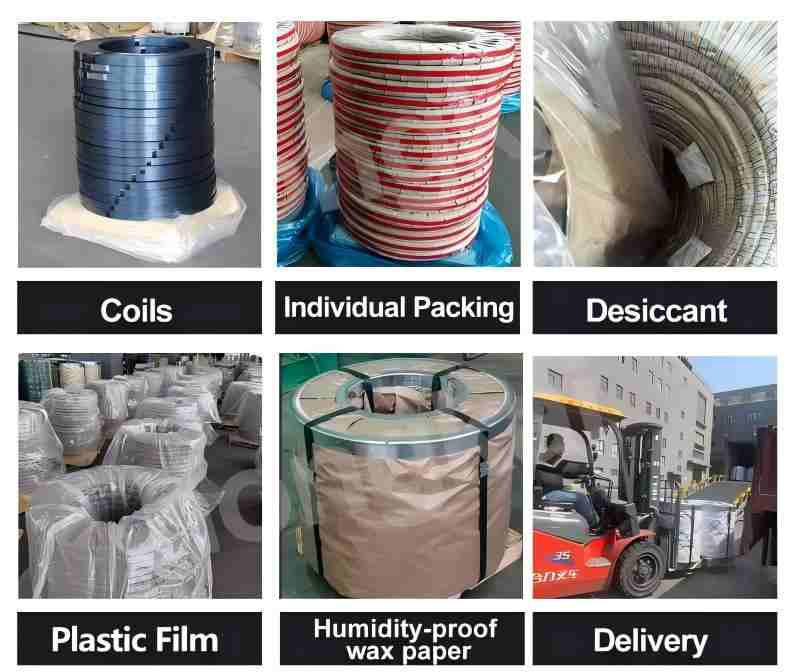
JUHONG's sea-worthy steel strapping packaging can include metal anti-rust preventive desiccants inside each pallet, VCI anti-rust film, moisture-resistant wax paper externally, four straps for reinforcement, and fumigation-free wooden pallets or steel pallets.

JUHONG steel strapping sea-worthy packaging with VCI anti-rust film, metal anti-rust desiccants, moisture-resistant wax paper and reinforced pallets.
| Export Packaging Check | What Buyers Should Ask | Why It Matters |
| Inner anti-rust protection | Is VCI anti-rust film used? | Helps reduce direct moisture exposure around the coils |
| Internal desiccant | Are metal anti-rust preventive desiccants placed inside the pallet? | Helps absorb moisture inside the packed pallet |
| Outer protection | Is moisture-resistant wax paper used outside? | Adds protection against humidity and handling exposure |
| Pallet type | Is the pallet fumigation-free wood, fumigated wood or steel? | Affects export handling, compliance and storage stability |
| Pallet reinforcement | How is the pallet secured? | Four straps help keep the packed pallet stable during movement |
| Container condition | Is the container dry before loading? | A damp container increases rust risk |
| Container desiccant | Will desiccant be placed inside the container? | Temperature changes during sea freight may create condensation |
| Storage before loading | Is steel strapping stored in a dry area before shipment? | Pre-shipment moisture exposure can increase rust risk |
This kind of checklist is especially useful for distributors who need to protect resale inventory and reduce end-customer complaints.
Why Container Desiccant Matters During Sea Shipment
During sea freight, containers may experience temperature changes between day and night, between different climate zones, or between port and inland transportation. These temperature changes can create condensation inside the container.
When water vapor condenses inside a container, packaging materials and metal products may be affected. For steel strapping, this does not mean the product itself is defective. It means the shipment environment created moisture risk.
For higher-risk routes, buyers can discuss container desiccant with the supplier or forwarder. Pallet-level anti-rust packaging protects the steel strapping directly, while container desiccant helps reduce moisture inside the container environment.
This is why rust prevention for steel strapping should not only focus on the coil surface. It should also include:
Anonymous Buyer Example: Middle East Distributor Concerned About Rust
A distributor in a Middle Eastern market was concerned about rust risk during sea shipment. The buyer planned to import steel strapping by container and wanted to reduce complaints from local customers after arrival.
JUHONG explained that sea freight can create moisture risk because temperature changes inside the container may cause condensation. The recommended approach was not only to choose a suitable steel strapping finish but also to confirm sea-worthy pallet packaging and moisture control during shipment.
The packaging logic included:
using VCI anti-rust film around the steel strapping pallet
placing metal anti-rust preventive desiccants inside the pallet
covering the outside with moisture-resistant wax paper
reinforcing the pallet with four straps
using suitable fumigation-free wooden pallets or steel pallets
placing suitable desiccant inside the container when needed
storing the steel strapping in a dry place after arrival
keeping the original packaging intact before use
This example shows an important point for B2B buyers: rust prevention is a process, not only a coating choice.
What Importers and Distributors Should Confirm Before Ordering
Before ordering steel strapping for sea freight, buyers should send enough shipment and storage information to the supplier. This helps the supplier recommend a more suitable finish, coil type, and packaging method.
If the buyer is still confirming basic steel strapping applications, sizing logic and safe handling, JUHONG's steel strapping guide can be used as a supporting reference before finalizing the inquiry.
| Information To Send | Example |
| Destination market | Peru, Chile, Thailand, Spain, Middle East market, etc. |
| Application | Steel coils, steel pipes, timber, glass, construction materials, heavy pallets |
| Shipping method | Sea freight, inland transport, long container route |
| Storage condition | Dry warehouse, humid warehouse, outdoor transfer, long storage time |
| Surface finish preference | Blue/waxed, black painted/waxed, galvanized or zinc-coated |
| Steel strapping size | Width, thickness, coil type and coil weight |
| Packaging request | VCI film, desiccant, wax paper, pallet type, container desiccant |
| Documents needed | Specification sheet, inspection documents or third-party testing if required |
| Photo or video request | Packaging photo or loading video before shipment |
For distributors, this checklist is not only about purchasing. It also helps create a receiving and storage standard for local warehouse teams.
For buyers using different coil formats, the coil type should also be confirmed carefully. A separate guide to ribbon wound, oscillated wound and jumbo steel strapping coils can help buyers avoid mismatches with storage, handling or automatic strapping lines.
Common Mistakes That Increase Rust Complaints
Only Comparing Unit Price
Some buyers compare steel strapping only by price per ton or price per coil. However, when the goods are shipped by sea, packaging quality can strongly affect the final receiving condition.
Low-cost packaging may create higher complaint risk if the route is long, the destination is humid, or the goods will stay in the warehouse before resale.
Choosing Surface Finish Without Explaining the Route
If a buyer only asks for blue steel strapping, black painted steel strapping, or galvanized steel strapping without explaining the shipment route and storage condition, the supplier may not fully understand the corrosion risk.
A better inquiry should include destination country, sea freight route, storage environment, and expected inventory period.
Ignoring Damaged Packaging After Arrival
If outer wax paper, VCI film, or pallet covering is damaged during unloading, moisture can reach the steel strapping more easily. Buyers should inspect pallet condition when the container is opened and record any damage immediately.
Opening All Pallets Too Early
After arrival, some warehouses open all pallets for inspection or repacking. If the goods are then stored in a humid environment, the original anti-rust protection is lost.
For better storage, buyers should keep the original packaging intact before use and open pallets only when needed.
Storing Steel Strapping in a Damp Warehouse
Even good sea-worthy packaging can be affected by long-term exposure to humidity. Steel strapping should be stored in a dry place, away from rain, wet floors, and heavy condensation. Buyers should also avoid placing unpacked coils near doors, open loading areas, or other high-humidity zones.
Receiving Checklist After Steel Strapping Arrives
When the container arrives, importers and distributors should check the goods before moving them into long-term storage.
| Receiving Check | What To Look For |
| Container condition | Water marks, wet floor, strong humidity or damaged container ceiling |
| Pallet condition | Broken pallet, collapsed pallet, damaged wrapping or torn wax paper |
| Outer packaging | Whether moisture-resistant wax paper is still intact |
| Inner protection | Whether VCI film or internal wrapping was damaged |
| Coil condition | Visible rust, wet surface, deformation or loose winding |
| Label and specification | Whether size, coil type and finish match the order |
| Storage plan | Whether goods will be kept dry and used within a reasonable period |
If rust is found, buyers should not immediately assume one single cause. It is better to check product finish, packaging condition, container environment, unloading process, and warehouse storage together.
How JUHONG Supports Export Steel Strapping Buyers
JUHONG is an industrial packaging materials manufacturer founded in 1997. For steel strapping buyers, JUHONG can discuss steel strapping specification, surface finish, coil type, pallet type, and export packaging needs before shipment.
For sea freight orders, buyers can confirm packaging details such as
VCI anti-rust film
metal anti-rust preventive desiccants inside the pallet
external moisture-resistant wax paper
pallet reinforcement with four straps
fumigation-free wooden pallets or steel pallets
container desiccant recommendation when needed
packaging photos or video before shipment when arranged
JUHONG also has testing and inspection equipment related to steel strapping quality control, such as tensile testing equipment, automatic bending testing equipment, camber testing equipment, and salt spray rust prevention testing equipment. Exact test reports, third-party documents, or standard-related documents should be confirmed according to the product and order requirement.
If the order also includes joint parts, buyers should confirm the matching steel strapping seals, strap width, tool type and joint method together with the steel strapping specification.
FAQ
1.Does all steel strapping rust during sea shipment?
Not all steel strapping will rust during sea shipment, but steel is naturally sensitive to moisture. Rust risk increases when the shipment has high humidity, long transit time, container condensation, damaged packaging, or poor storage after arrival.
2.Is galvanized steel strapping always necessary for export?
No. Galvanized or zinc-coated steel strapping can be useful for higher corrosion-risk applications, but it is not the only solution for every export order. Buyers should also consider surface finish, pallet packaging, container moisture control, and storage conditions.
3.What is the difference between surface finish and export packaging?
"Surface finish” refers to the treatment on the steel strapping itself, such as blue/waxed, black painted/waxed, or zinc-coated finish. Export packaging refers to the protection around the packed goods, such as VCI film, desiccant, moisture-resistant wax paper, pallet type, and reinforcement.
4.How can I reduce rust risk when importing steel strapping?
Send the supplier your destination market, shipping route, storage condition, application, and expected storage time. Confirm suitable surface finish, seaworthy pallet packaging, VCI film, desiccant, moisture-resistant wax paper, and container moisture-control needs.
5.Should distributors ask for VCI film and desiccant?
For sea freight, humid markets, or long storage conditions, distributors should discuss VCI film and desiccant with the supplier. These packaging materials help reduce moisture exposure during shipment and storage.
6.Should desiccant be placed inside the container?
For routes with high humidity or strong temperature changes, container desiccant may help reduce condensation risk inside the container. Buyers can discuss this with the supplier and forwarder before shipment.
7.What should I check if steel strapping arrives with rust?
Check the container condition, pallet wrapping, VCI film, wax paper, storage condition, surface finish, and whether the packaging was damaged during unloading. Rust may come from shipment moisture, damaged packaging, or storage conditions after arrival.
8.How should steel strapping be stored after arrival?
Steel strapping should be stored in a dry place. Buyers should keep the original anti-rust packaging intact before use, avoid wet floors or rain exposure, and use the goods as soon as practical after arrival.
9.Can JUHONG provide steel strapping packaging photos or video before shipment?
Packaging photos or videos can be arranged according to the order and communication requirements. Buyers should confirm this request before shipment.
10.What information should I send before requesting a steel strapping quotation?
Send the application, destination country, shipping method, storage condition, required width and thickness, surface finish preference, coil type, pallet requirement, packaging requirement, and document needs.
Request Steel Strapping Packaging and Specification Support
If you import steel strapping by sea, do not only compare width, thickness, and price. Rust prevention depends on the full export packaging plan.
Contact JUHONG to discuss steel strapping specifications, surface finish, pallet packaging, VCI film, desiccant, moisture-resistant covering, and quotation details for your market.
![]() juhong steel strapping Brochure.pdf
juhong steel strapping Brochure.pdf
![]() Juhong Packing Materials' Brochure.pdf
Juhong Packing Materials' Brochure.pdf
 简体中文
简体中文