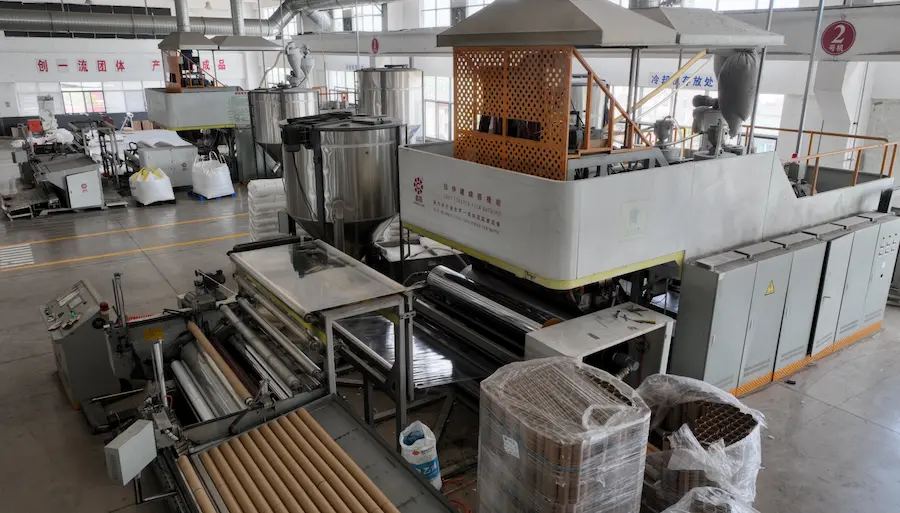
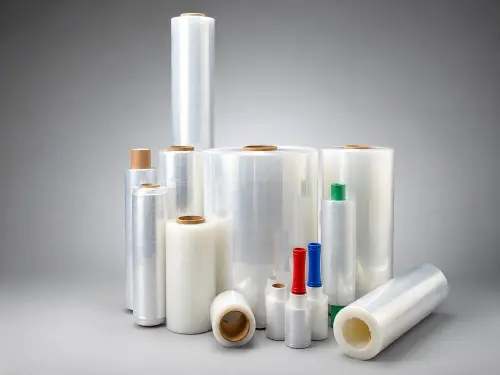
Cast stretch film, also sold as cast stretch wrap, is made by melting polyethylene resin and extruding it through a flat die into a continuous sheet. The sheet is cooled on a chill roll, measured for thickness, slit to the required width, and wound into hand, machine, or jumbo rolls.
For distributors and bulk buyers, these steps matter because each one leaves a trace in the finished roll: gauge consistency, roll build, clarity, and how the film behaves on a wrapper. The sections below explain where those properties are set, and how to read the test data that comes with a shipment.

What Is Cast Stretch Film Made From?

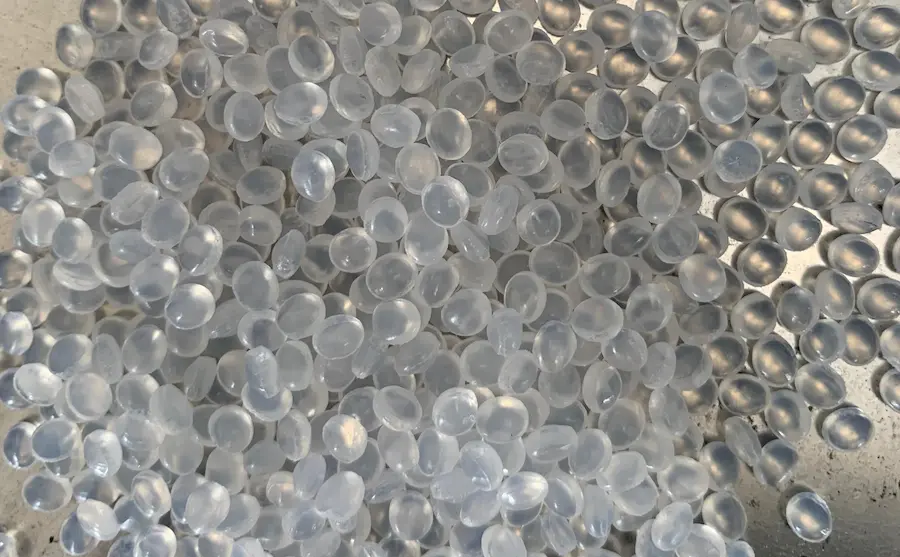
Most stretch wrap film used on pallets is based on linear low-density polyethylene, or LLDPE. Manufacturers select resin grades and blends according to the intended balance of stretch, strength, cling, and processing behavior.
JUHONG uses 11-layer coextrusion to produce its multilayer cast stretch film, combining multiple melt streams into a single film web. Coextrusion also allows the two outer surfaces to be formulated differently. On a one-side-cling film, for example, the cling surface has to face inward during wrapping; if the roll is loaded the wrong way round, adjacent pallets can stick together. This is an orientation issue, not necessarily a film defect.

The Cast Stretch Film Manufacturing Process

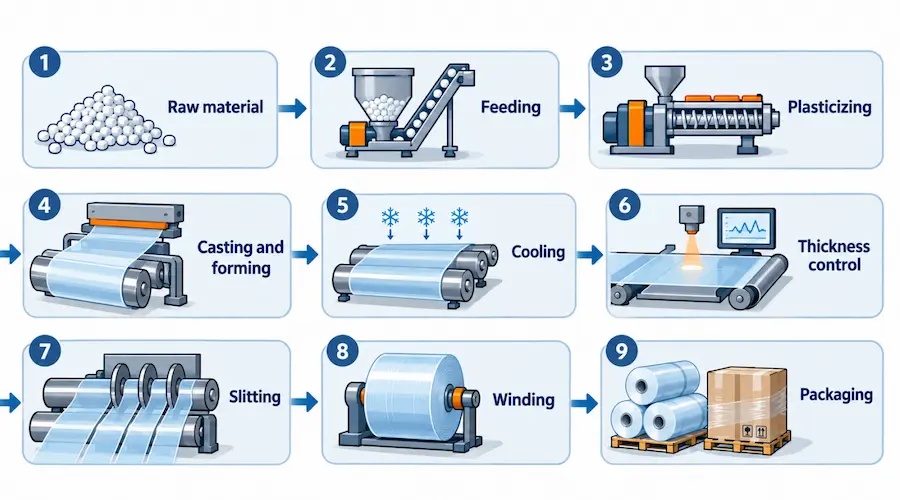
At JUHONG, the main production stages are:
Raw material → Feeding → Plasticizing → Casting and forming → Cooling → Thickness control → Slitting → Winding → Packaging
The arrangement of downstream equipment varies between manufacturers. A line may produce finished rolls directly, or make jumbo rolls that undergo a separate slitting and rewinding operation.
Resin Feeding and Plasticizing

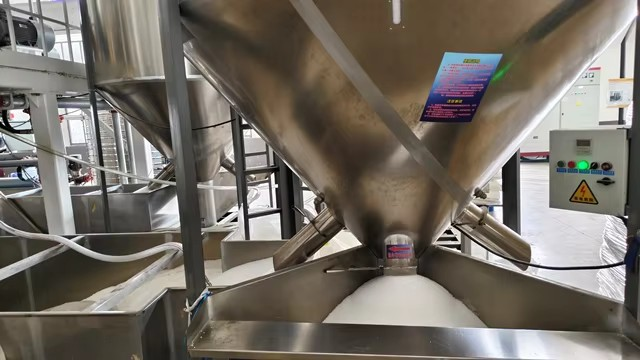
Resin pellets enter the extrusion system through a feeding unit. A rotating screw conveys the material through a heated barrel, where heat and mechanical work turn it into a melt.
Consistent feeding and mixing keep the melt supply steady. Material handling matters too: foreign material entering with the resin can end up as a gel or black speck in the finished film. The temperature profile depends on the resin blend and equipment; overheating or incomplete melting introduces defects before the film ever reaches the die.
Cast Film Extrusion Through a Flat Die

The melt passes through a wide, narrow die opening to form a continuous sheet. On a coextrusion line, the layers come together as part of this flow path.
Film thickness depends on the balance between melt output, film width, and the speed at which the film is drawn away, as well as the die settings. An unstable melt supply or uneven flow across the die creates gauge variation that stays in the finished roll.
Cooling the Film on a Chill Roll
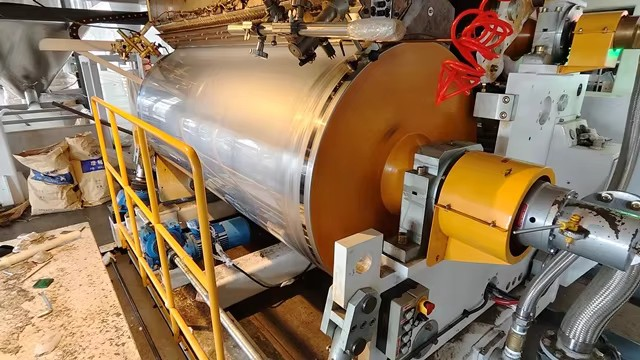
As the melt leaves the die, it is laid directly onto a large water-cooled chill roll. Contact with the cold metal surface sets the film within a very short distance of the die.
This rapid, even cooling is what gives cast film its characteristic clarity and uniform gauge. It is also one reason cast film is widely used for machine wrapping at high pre-stretch levels, where thin spots are more likely to cause breaks. By contrast, blown film cools more slowly in the air, which produces different properties (see the comparison below).
Measuring and Controlling Film Thickness

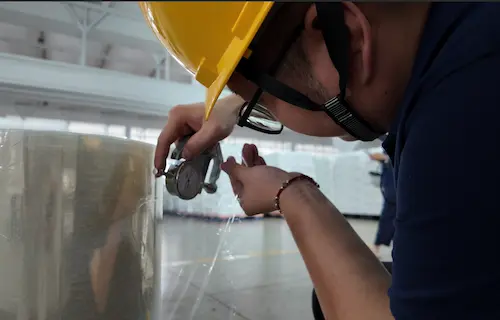
Throughout production, JUHONG takes film samples and tests their thickness. Rolls are also randomly checked for width, weight, appearance, and elongation-related performance.
A sample shows the thickness at that point in the run, so where and how often samples are taken matters. Measuring at several points across the width shows more than a single reading. An average can also hide local variation: a film may average close to its nominal thickness while containing thinner and thicker bands. Those differences can also build up as successive layers are wound, showing up as a hard ridge or soft band on the roll.
For bulk orders, a useful specification defines the nominal thickness, allowable variation, and measurement method. It should be clear whether the reported figure is an average, an individual reading, or a range. That distinction makes a thickness report much more useful than a single number on a quotation.
In the US, thickness is usually quoted in gauge rather than microns: 80 gauge is about 20 microns. Our guide on what gauge stretch film you need explains how gauge relates to load weight.

Slitting, Winding, and Packing

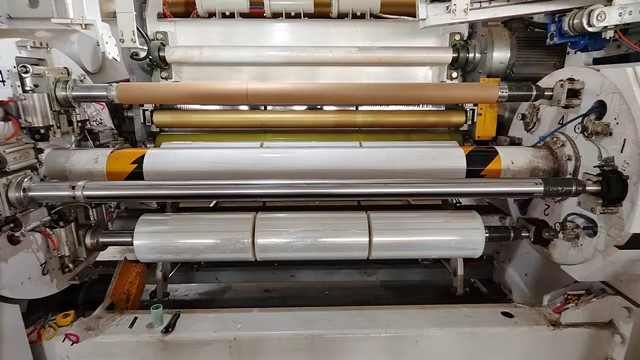
Slitting converts the wider film web into the required widths. Winding builds the film into rolls, with tension and alignment controlled to suit the material and roll format.
The roll format is decided at this stage. Hand stretch film is wound on lighter rolls that an operator can carry and wrap by hand. Machine stretch wrap film goes on heavier rolls built to unwind evenly on automatic wrappers, where consistent gauge and roll build matter most. A converter buying jumbo rolls also has to consider the roll dimensions and core fit of its rewinding equipment.
Packing protects the film edges and cores during handling and transport. The physical product is connected with the ordered grade and dimensions through roll identification. Distributors who repack under their own label should keep the supplier's product and batch references traceable through repacking.
Finished Roll Specifications and Quality Checks
Before a new film goes into regular supply, these are the points worth comparing across the spec sheet, the sample, and the test report:
| Check | What the buyer needs to compare |
| Thickness (gauge or micron) and width | Nominal dimensions, measured variation, and sampling method |
| Roll weight and length | Whether weight means net film or includes the core; how length is stated or verified |
| Core and roll dimensions | Fit with the customer's wrapper, dispenser, or converting equipment |
| Tensile properties and elongation | Test method, specimen dimensions, and machine or transverse direction |
| Cling, puncture resistance, and tear resistance | Test conditions and relevance to the intended wrapping application |
| Elastic recovery and stress retention | How the film responds after stretching and how its force changes with time |
Reading a Test Report: A Worked Example

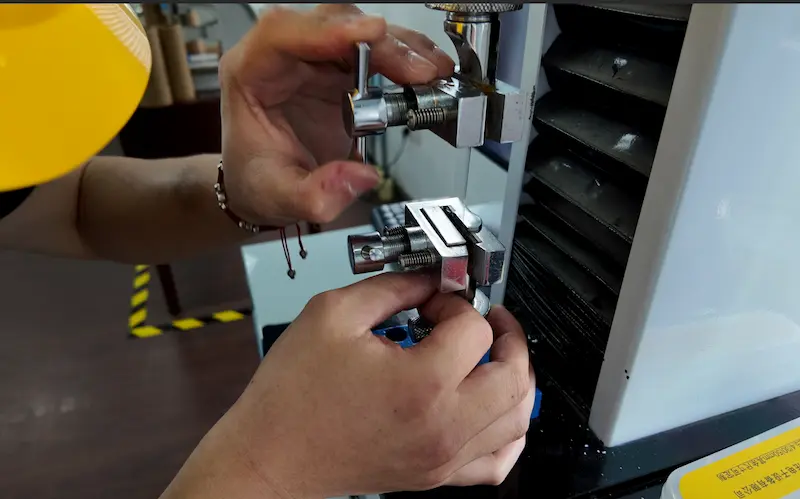
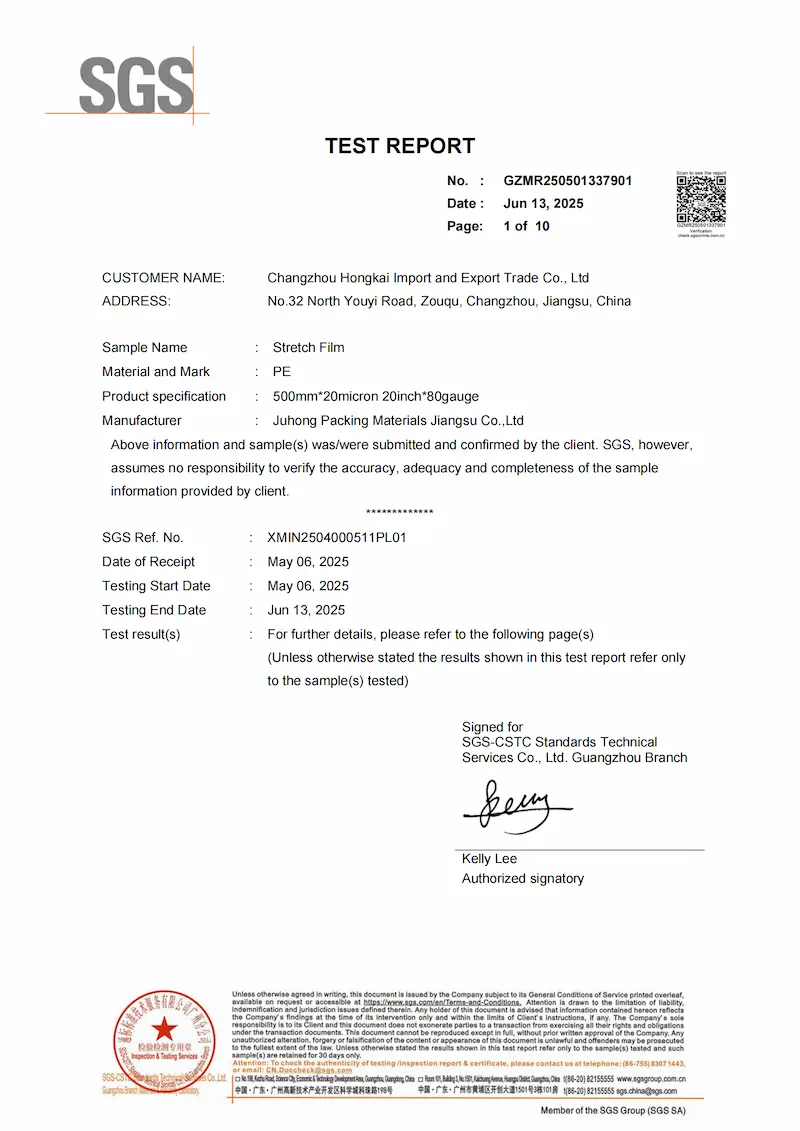
A third-party report shows why test conditions matter. In one SGS test of a JUHONG PE stretch film sample specified as 500 mm × 20 micron (80 gauge), the spec of our 80 gauge hand stretch film, tested under ASTM D4649-20 Table 1:
The tensile specimens measured 0.019 mm thick, slightly under the 20-micron nominal. A good report states the measured specimen thickness, not just the ordered gauge.
Elongation at break was 550% in the lengthwise (machine) direction and 770% in the transverse direction (ASTM D882).
Elmendorf tear resistance was 1 N lengthwise and 3 N transverse (ASTM D1922).
Protrusion puncture was 1.35 N·m (ASTM D5748).
The same film gave quite different results depending on direction. Cast film typically tears more easily along the machine direction, so a result quoted without its direction cannot be compared with another supplier's figure. Other grades and thicknesses test differently, so ask for the report that matches the SKU you are buying.
Elastic recovery, permanent deformation, and stress retention are covered by a separate method, ASTM D5459-95(2025). When comparing suppliers, check that both reports use the same method, direction, and specimen thickness before comparing the numbers.
Visible Defects
At JUHONG, visual inspection checks whether the roll is flat and free from black spots, air bubbles, perforations, lumps, broken ends, and roll damage. After production, finished rolls can be sampled again and issued a quality certificate.
On the buyer's side, gels, uneven clarity, gauge bands, or film blocking can have more than one cause, and appearance alone rarely identifies which. When reporting a suspected problem, keep an affected roll with its batch label, note whether the defect continues through the roll, and photograph it. That gives the supplier something to trace back to production records.
Cast vs. Blown Stretch Film: Manufacturing Differences
The main difference between cast and blown stretch film is how the molten polymer is shaped and cooled. Cast film forms as a flat web and is quenched on a chill roll; blown film forms as a tube that is inflated into a bubble and cooled by air before being collapsed.
For a closer look at clarity, unwind behavior, puncture resistance, and pallet-wrapping applications, read our cast vs. blown stretch film comparison.
Frequently Asked Questions
1. Is Cast Stretch Film the Same as Pre-Stretched Film?
No. Cast describes the film's manufacturing method. Pre-stretched describes film that has been stretched during an additional manufacturing or converting stage before supply. A film can be both cast and pre-stretched, but a cast-film designation alone does not mean it has been pre-stretched.
2. Can Cast Stretch Film Be Supplied in Jumbo Rolls for Rewinding?
Yes. JUHONG supplies jumbo stretch film rolls for converters and distributors who rewind them into their own roll sizes. A converter needs to match the supplied roll's width, diameter, weight, core dimensions, and winding characteristics to its equipment. The film grade also needs to suit the end customer's hand or machine application.
3. Can Elongation at Break Be Used as a Machine Pre-Stretch Setting?
No. Elongation at break is measured by stretching a small test specimen until it fails. In the SGS example above, a result of 550% lengthwise does not mean the film can run at 550% pre-stretch on a wrapper. The working setting depends on the wrapper, application speed, pallet profile, and required containment, and should be confirmed with a trial of the proposed film grade. Our guide to choosing machine stretch film for different wrappers covers this in more detail.
Source Cast Stretch Film for Your Product Range

As a stretch wrap film manufacturer, JUHONG supplies film for hand and machine use, along with jumbo rolls for converting. For distributors building a wider range, we also supply color stretch film, coreless stretch film, and mini stretch film for bundling. Film width, thickness, roll weight, and packaging can be customized, with OEM options for distributors and importers. Finished rolls can be sampled and issued a quality certificate, and third-party inspection before shipment can be arranged on request.
For a new SKU or a supplier change, start with the current film specification and the customer's application. State net film weight separately from core weight where relevant, and agree on which dimensions and test methods will be used to evaluate the sample.
Explore JUHONG's stretch film range to discuss the roll format and specification for your market.
References
ASTM International. ASTM D5459-95(2025): Machine Direction Elastic Recovery, Permanent Deformation, and Stress Retention of Stretch Wrap Film. Public scope and significance statements.
ASTM International. ASTM D4649-20: Standard Guide for Use of Stretch Films and Wrapping Application. Table 1 is cited in the SGS report’s protrusion puncture test, alongside ASTM D5748-95(2019)
![]() juhong-stretch-film-brochure.pdf
juhong-stretch-film-brochure.pdf
 简体中文
简体中文